Football Formations Explained: 4-3-3 vs 4-2-3-1 vs 3-5-2 – Which System Works Best?
Learn how the 4-3-3, 4-2-3-1 and 3-5-2 football formations work, their strengths, weaknesses, and which teams use them successfully.
Football is much more than scoring goals. Behind every successful team is a tactical system that helps players defend, attack and control the game. A team’s formation determines where players are positioned on the pitch and how they work together.
Among the most popular formations in modern football are the 4-3-3, 4-2-3-1, and 3-5-2. Each system has unique strengths and weaknesses, making it suitable for different playing styles and opponents.
In this guide, we explain how each formation works and when it is most effective.
What Is a Football Formation?
A football formation shows how outfield players are arranged on the pitch. The goalkeeper is not included in the numbers.
For example, a 4-3-3 means:
• 4 defenders
• 3 midfielders
• 3 attackers
While the formation provides a starting structure, players constantly move during matches depending on whether the team is attacking or defending.
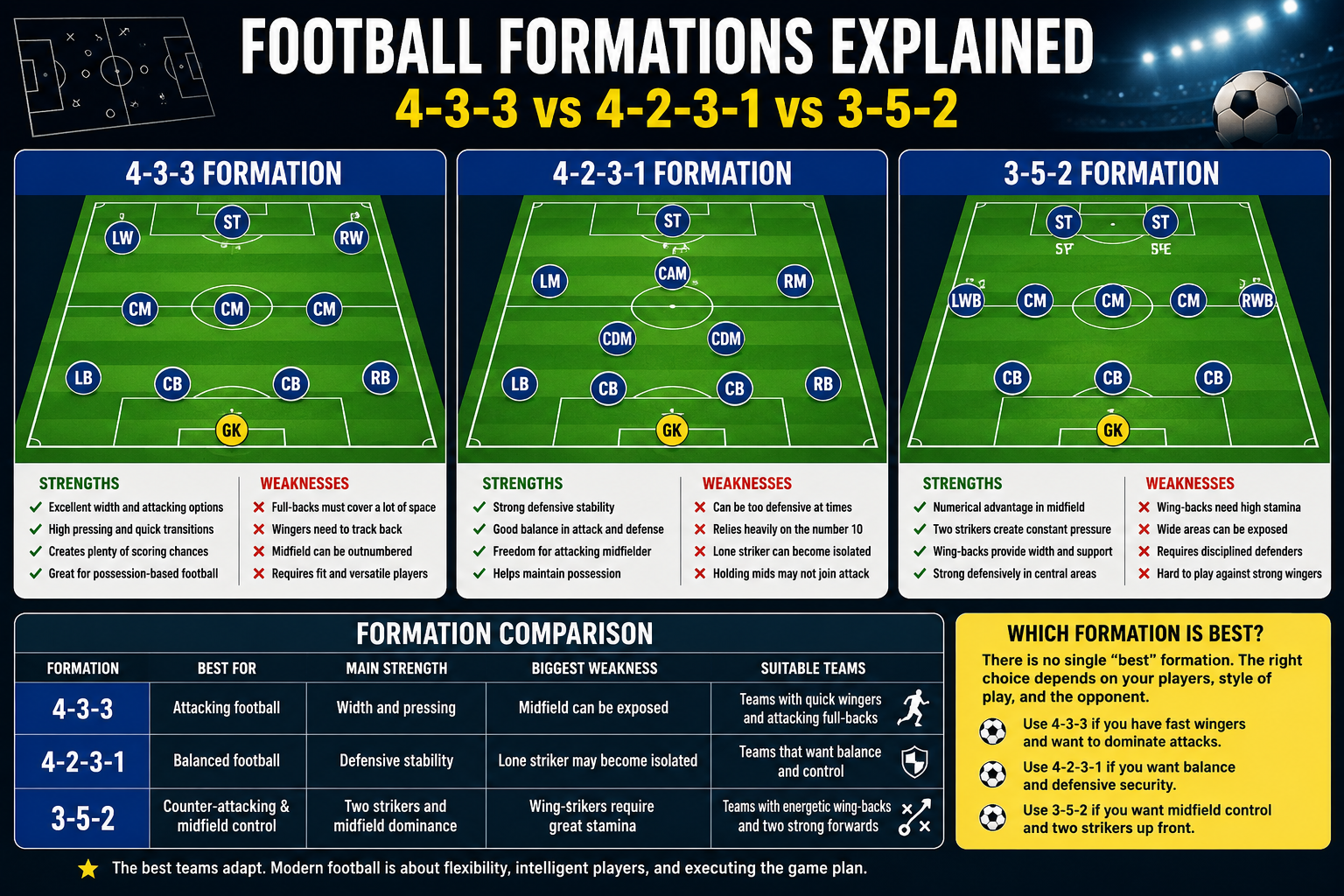
The 4-3-3 Formation
The 4-3-3 is one of the most attacking formations in football. It features four defenders, three midfielders and three forwards.
Advantages
• Excellent width through the wingers.
• Strong pressing from the front.
• Creates many attacking opportunities.
• Midfield can control possession when players are technically gifted.
Disadvantages
• Full-backs often need to cover large areas.
• Wingers must also help defensively.
• A weak midfield can easily be outnumbered.
Teams That Use It
Many top clubs have successfully used the 4-3-3 because it suits possession-based football and high pressing. It is ideal for teams with quick wingers and creative midfielders.
The 4-2-3-1 Formation
The 4-2-3-1 is one of the most balanced systems in modern football. It uses two defensive midfielders to protect the defence while allowing attacking players greater freedom.
Advantages
• Strong defensive stability.
• Good balance between attack and defence.
• Attacking midfielder has freedom to create chances.
• Helps teams maintain possession.
Disadvantages
• Can become too defensive if the holding midfielders rarely join attacks.
• Relies heavily on a creative number 10.
• The lone striker can become isolated without support.
Teams That Use It
Many national teams and club sides favour this formation because it adapts well to different opponents and offers defensive security.
The 3-5-2 Formation
The 3-5-2 uses three central defenders, five midfielders and two strikers. Wing-backs play a crucial role by supporting both defence and attack.
Advantages
• Numerical advantage in midfield.
• Two strikers create constant pressure on defenders.
• Wing-backs provide width.
• Strong defensive cover in central areas.
Disadvantages
• Wing-backs need exceptional fitness.
• Wide spaces can be exposed if wing-backs are caught out of position.
• Teams without disciplined defenders may struggle.
Teams That Use It
The 3-5-2 is often chosen by coaches who want defensive solidity while keeping two forwards high up the pitch.
Comparing the Three Formations
Formation
Best For
Main Strength
Biggest Weakness
4-3-3
Attacking football
Width and pressing
Midfield can be exposed.
4-2-3-1
Balanced football
Defensive stability
Lone striker may become isolated.
3-5-2
Counter-attacking and midfield control
Two strikers and midfield dominance
Wing-backs require great stamina.
Which Formation Is Best?
There is no single “best” formation. The right choice depends on the players available, the coach’s philosophy and the opponent.
• Teams with fast wingers often perform well in a 4-3-3.
• Teams looking for balance usually prefer the 4-2-3-1.
• Teams with energetic wing-backs and two quality strikers can thrive in a 3-5-2.
The world’s best coaches frequently switch formations during matches to adapt to changing situations, proving that flexibility is just as important as the formation itself.
Final Thoughts
Football formations continue to evolve as tactics become more advanced. While the 4-3-3, 4-2-3-1 and 3-5-2 remain among the most popular systems, success ultimately depends on how well players understand their roles and execute the coach’s game plan.
Whether you are a fan, a coach or an aspiring player, understanding these formations will help you appreciate the tactical battles that unfold during every football match.