10 Young African Women Footballers to Watch in 2026
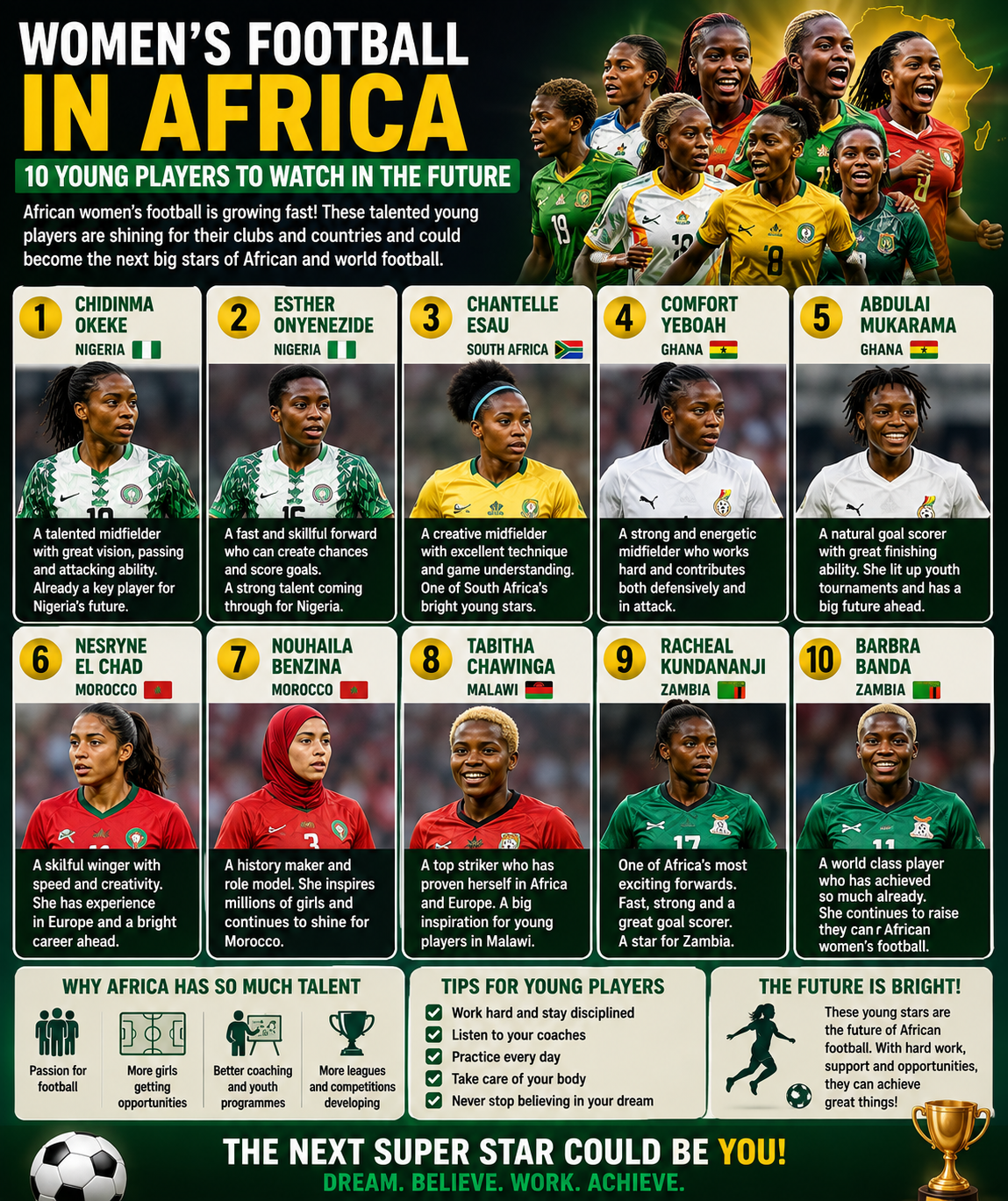
Meet 10 young African women footballers with the talent and potential to become future stars of African and international women’s football.
Why Young Players Matter
The future of African women's football depends heavily on youth development.
Strong youth programmes can help players develop:
Technical skills
Tactical understanding
Physical fitness
Confidence
Match experience
Professional discipline
CAF's latest women's football report showed strong growth in registered female players and youth competitions across Africa, showing that more young players are getting opportunities to develop.
Chidinma Okeke — Nigeria
Chidinma Okeke is a Nigerian midfielder who has already gained experience at senior international level.
Her ability to play in midfield and contribute defensively makes her an interesting player to follow.
Nigeria has a long history of producing talented midfielders, and players like Okeke could become important parts of the country's future.
Her development will be worth watching as she gains more experience at club and international level.
Esther Onyenezide — Nigeria
Esther Onyenezide is another Nigerian player who has attracted attention through youth and senior football.
She has represented Nigeria at youth level and has continued developing her career.
Nigeria's strong football culture provides talented young players with opportunities to compete at different levels.
For Onyenezide, continued playing time and experience will be important as she works toward establishing herself at the highest level.
Chantelle Esau — South Africa
South Africa has become one of the leading women's football nations in Africa.
The country has developed a strong women's football system, and young players are increasingly getting opportunities to learn from experienced professionals.
Chantelle Esau is one of the young South African players whose development football fans can follow.
Her progress is another example of the growing depth of women's football talent in the country.
Comfort Yeboah — Ghana
Ghana has a proud history in women's football and continues to develop young players through youth competitions.
Comfort Yeboah has represented Ghana at youth and senior levels and has experience playing international football.
Ghana's Black Queens and youth teams continue to provide pathways for talented female players.
With more experience, young players from this system could become important figures in African football.
Abdulai Mukarama — Ghana
Mukarama Abdulai became known internationally after her impressive performances for Ghana's youth teams.
She has shown the goal-scoring ability that can make a young forward stand out.
Scoring goals at youth level does not guarantee success in senior football, but it provides an excellent foundation.
Her continued development will be important to watch.
Nesryne El Chad — Morocco
Morocco has invested heavily in women's football in recent years.
Nesryne El Chad is part of a generation of Moroccan players who have benefited from the country's growing football structure.
She has already gained international experience with Morocco and has played club football in Europe.
Her progress demonstrates how African players can develop through a combination of domestic and international opportunities.
Nouhaila Benzina — Morocco
Nouhaila Benzina has already become a well-known name in African women's football.
She made history at the 2023 FIFA Women's World Cup as the first player to wear a hijab during a senior Women's World Cup match.
Her story goes beyond football.
She has become a role model for girls who may previously have felt that professional football was not a place for them.
Tabitha Chawinga — Malawi
Tabitha Chawinga is not a newcomer, but her career is important when discussing the future of African women's football.
She has shown what African women footballers can achieve internationally.
Her career can inspire younger players from Malawi and other African countries to believe that they can compete at the highest levels.
She is also an example of how talent from countries with smaller football systems can reach major international competitions.
Racheal Kundananji — Zambia
Racheal Kundananji has quickly become one of the most exciting African forwards.
The Zambian striker has played at the highest level in Europe and has become an important player for the Copper Queens.
Her speed, strength and ability to score make her a player that African football fans should continue following.
Her success also shows the growing international value of African women's football talent.
Barbra Banda — Zambia
Barbra Banda has already established herself as one of Africa's biggest women's football stars.
Although she is no longer simply a "young prospect", her career is still important because she represents the next level that African players can reach.
She has played professionally in China and the United States and has been a major player for Zambia.
Her performances can inspire younger African players who want to build international careers.
Why Africa Has So Much Women's Football Talent
Africa has always had football talent.
The bigger challenge has been creating enough opportunities for that talent to develop.
Things are changing.
More girls are playing.
More countries are creating women's leagues.
More players are moving to professional leagues abroad.
More competitions are being organised.
The 2026 WAFCON expansion to 16 teams is another example of the wider growth of women's football in Africa.
Nigeria's recent success also shows the strength of the continent's established football nations. The Super Falcons won the 2025 WAFCON after beating Morocco 3–2 in the final.
But the rise of countries such as Zambia and Malawi shows that the women's game is spreading beyond the traditional powers.
What Can African Football Learn From These Players?
The careers of these players show that there is no single path to success.
Some developed mainly through domestic football.
Others moved abroad at a young age.
Some became famous through youth competitions.
Others had to wait several years before getting their big opportunity.
The important lesson is that development takes time.
A young girl playing football today does not need to become a superstar immediately.
She needs opportunities to keep improving.
What Young Girls Can Learn From Them
1. Keep Practising
Professional players did not become successful overnight.
2. Take Coaching Seriously
Good advice can help improve weaknesses.
3. Learn From Mistakes
A bad match does not mean a bad career.
4. Take Education Seriously
Football careers are not guaranteed.
5. Take Care of Your Body
Rest, nutrition and injury prevention are important.
6. Be Patient
Some players develop faster than others.
7. Believe in Yourself
Many successful footballers started with very little.
The Future of African Women's Football
The future looks promising.
The 2026 WAFCON features 16 nations, and the competition also plays an important role in the road to the 2027 FIFA Women's World Cup.
Countries such as Nigeria, South Africa, Morocco and Zambia already have strong women's football programmes, while countries such as Malawi are showing that smaller football nations can also make major progress.
The next step is to make sure more girls have access to the same opportunities.
If African football continues investing in youth development, women's leagues, coaching and player welfare, the continent could produce many more world-class players.
Frequently Asked Questions
Who is the best young African women's footballer?
There is no single answer. Players develop at different speeds, and "best" depends on position, competition and current form.
Which African countries have strong women's football teams?
Nigeria, South Africa, Morocco and Zambia are among the leading teams, while countries such as Malawi have recently made major progress.
Who is Racheal Kundananji?
Racheal Kundananji is a Zambian forward who plays for Bay FC in the NWSL and represents Zambia internationally.
Which African women's team has won the most WAFCON titles?
Nigeria's Super Falcons have won the most, with 10 titles.
Is African women's football growing?
Yes. The expansion of WAFCON to 16 teams and the increasing number of players and competitions across the continent are signs of continued growth.
African women's football is entering an exciting period.
The continent already has established stars, but the next generation is also coming through.
From Nigeria and Ghana to Morocco, Zambia, South Africa and Malawi, talented players are showing that African women can compete at the highest levels of the sport.
The real goal, however, should be bigger than producing a few famous players.
Africa needs a football system where thousands of girls can play, learn, compete and build a future through football.
The next global women's football superstar could already be training on a small football field somewhere in Africa.
She just needs the opportunity to be discovered.