
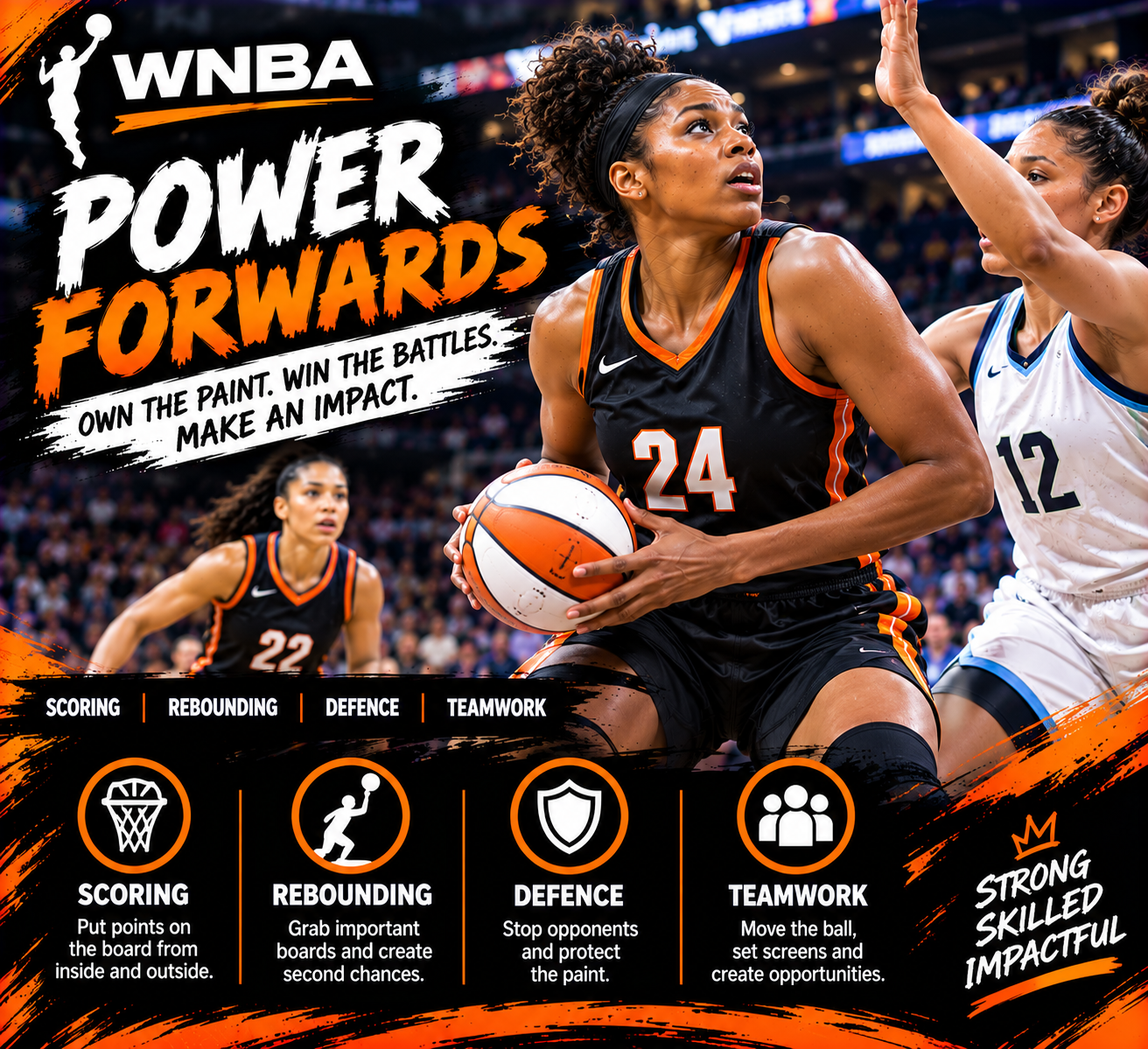
WNBA Power Forwards: Roles, Skills, Rebounding, and Defence
Learn how WNBA power forwards help their teams score inside, collect rebounds, defend the basket, and win games through strength and skill.
WNBA Power Forwards: The Players Who Bring Strength and Skill
In the Women’s National Basketball Association (WNBA), power forwards play an important role in helping teams compete and win games. They often use their strength, height, skill, and smart movement to score near the basket, collect rebounds, and defend against opponents.
Power forwards are traditionally known as the number four position. However, modern players in this role can do much more than play close to the basket. Many can also shoot from outside, pass to teammates, and move around the court to create scoring chances.
Their work may not always receive as much attention as scoring records, but power forwards can have a major effect on the result of a game.
1. What Is a Power Forward?
A power forward is a player who traditionally works around the basket and the area near the free throw line. The position often requires a combination of strength, good footwork, rebounding ability, and scoring skills.
Power forwards may help centres defend the basket, while also working with guards to create chances in attack.
The exact role depends on the coach and the player's strengths. Some power forwards are known for scoring inside, while others are skilled outside shooters who can stretch the defence.
2. Scoring Near the Basket
One of the main jobs of a power forward is to score close to the basket.
These players may use layups, short jump shots, strong moves near the rim, and shots after receiving passes from teammates. They must also learn how to protect the ball when defenders try to stop them.
Good footwork is important because it helps a player turn, change direction, and find a clear path to the basket.
Power forwards must also know when to pass. If defenders crowd around them, an open teammate may have a better chance of scoring.
3. Winning the Rebounding Battle
Rebounding is one of the most important parts of a power forward's job.
When a shot misses, both teams try to collect the ball. A power forward must watch the shot, find a good position, and compete for the rebound.
An offensive rebound gives the attacking team another chance to score. A defensive rebound helps the team regain possession and begin its next attack.
Strong rebounding can be especially important in close games. A team that collects more rebounds may gain extra scoring chances and prevent opponents from getting second chances.
4. Defending the Paint
The paint is the area near the basket. Power forwards often help protect this space by challenging shots, contesting rebounds, and making it difficult for opponents to score close to the rim.
Defending well requires more than strength. Players must understand positioning, avoid unnecessary fouls, and communicate with teammates.
They may also need to move away from the basket to defend opponents who can shoot from outside.
A power forward who can defend both inside and outside gives the coach more options when choosing a defensive plan.
5. Shooting From Outside
Modern basketball increasingly values players who can score from different areas of the court.
Some WNBA power forwards can shoot mid range jump shots and three pointers. This ability can force defenders to move farther away from the basket.
When a defender follows a power forward outside, more space may become available for teammates to drive toward the rim.
However, outside shooting is only one part of the position. Players must balance shooting with rebounding, defence, passing, and smart decisions.
6. Passing and Teamwork
Power forwards often work closely with centres and guards.
They may receive the ball near the basket, pass to a teammate who is free, or help create space by setting a screen. A screen can make it harder for a defender to follow an attacking player.
Good teamwork helps prevent the offence from becoming too easy to predict.
Power forwards also need to understand their teammates' movements. A well timed pass can create a simple scoring chance, even when the power forward does not take the shot.
7. Strength, Fitness, and Training
Power forwards need strength and fitness to compete throughout a game. They may have to battle for rebounds, hold their position against defenders, jump repeatedly, and move quickly from one end of the court to the other.
Training often includes strength exercises, shooting drills, footwork, defensive practice, and conditioning.
Recovery is equally important. Rest, suitable nutrition, and support from team training staff can help players prepare for the demands of a long season.
8. WNBA Power Forwards Who Stand Out
Several well known WNBA players demonstrate the value of strong and versatile forward play.
A'ja Wilson is known for her scoring, rebounding, defence, and ability to influence games around the basket. She has played as both a forward and a centre, showing how top players can contribute in different roles.
Breanna Stewart is a versatile forward who can score from inside and outside, collect rebounds, defend, and create chances for teammates.
Napheesa Collier is another example of a player who contributes through scoring, defence, rebounding, and movement without the ball.
Although their roles can change depending on the team's line-up, these players show why skill, versatility, and teamwork are valuable qualities for forwards.
9. How Power Forwards Help Their Teams Win
A good power forward can help a team in several ways. The player may score important baskets, win rebounds, protect the paint, or make a key defensive stop.
Their presence can also help other players. When a power forward draws defenders toward the basket, guards may find more space to shoot or drive.
Power forwards can be especially important during physical games when teams are fighting for every possession.
Still, basketball is a team sport. Success depends on players working together, following the coach's plan, and supporting each other throughout the game.
10. The Future of Power Forwards in the WNBA
The power forward position continues to develop. Today's players may be expected to defend different positions, shoot from outside, handle the ball, and make accurate passes.
Young players who want to play this position should work on strength, balance, shooting, rebounding, and defensive footwork. They should also learn how to read the game and make quick decisions.
As the WNBA continues to grow, power forwards who combine strength with skill and versatility will remain important to their teams.
WNBA power forwards play a major role in scoring, rebounding, defending, and supporting teammates. Their strength helps them compete near the basket, while their skills can make them useful across the court.
The best power forwards understand that their job is not only about scoring points. They must also defend well, collect rebounds, make smart passes, and help their teams work together.