
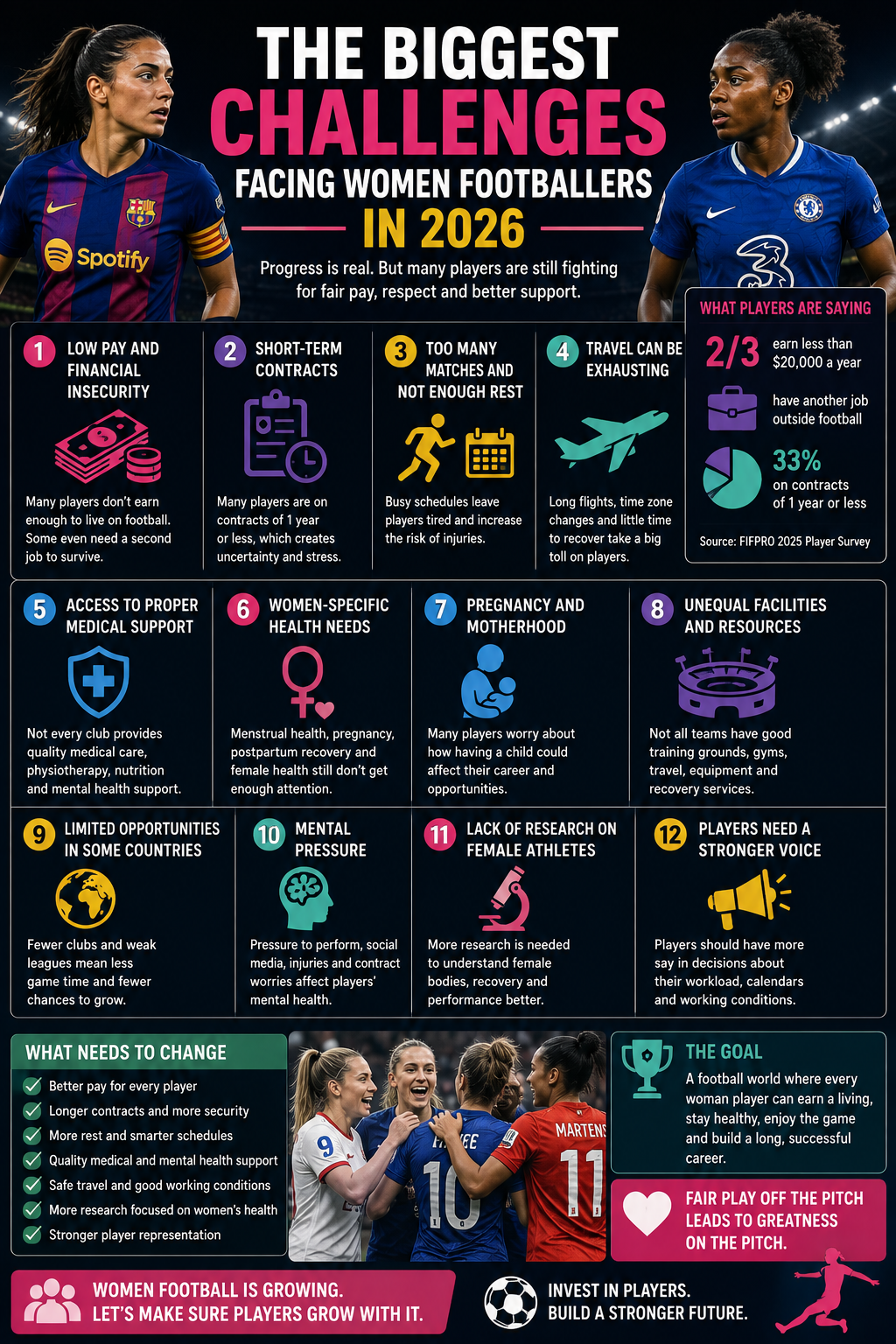
Biggest Challenges Facing Women Footballers in 2026
Discover the biggest challenges facing women footballers in 2026, from low pay and short contracts to busy schedules, travel, health support and safe working conditions.
Low Pay and Financial Insecurity
Money remains one of the biggest challenges in women’s football.
While a small number of top players earn strong salaries, many others do not earn enough to depend on football as their only source of income.
The FIFPRO survey found that 25% of the players questioned had another job outside football. It also found that 22% had no club contract at all.
This can make it difficult for players to plan their lives, pay for training needs and prepare for life after football.
The situation is improving in some major leagues, but the difference between the richest competitions and the rest remains large.
Short-Term Contracts
Having a football contract does not always mean having long-term security.
According to the same FIFPRO survey, 33% of players who had club contracts were on deals lasting one year or less.
A short contract can create uncertainty.
A player may have to think about where she will play next season, whether she will still have an income and whether she needs to find another club.
For younger players trying to build a career, this uncertainty can be especially difficult.
Too Many Matches and Not Enough Rest
Some elite players now face very busy schedules.
FIFPRO's research on the 2024-25 season found that the most heavily used players were playing 50 or more matches, while other players faced the opposite problem: not enough competitive games.
The 2025 national-team player survey also found that 58% felt they did not have enough rest before matches, while 57% said they did not have enough rest after matches.
Too many matches with too little recovery time can increase tiredness and injury risk.
Travel Can Be Exhausting
International football often means long flights and frequent travel.
Players may move between countries for club and national-team matches, sometimes with little time to recover before their next game.
FIFPRO's survey found that 77% of players travelled by air to at least one match or competition, while 75% travelled in economy class.
Travel is not the same as rest.
A player who spends hours on a plane may still need to train or play soon after arriving.
Access to Proper Medical Support
Professional athletes need good medical care.
But access to medical and performance support is not equal across women's football.
Some major clubs have doctors, physiotherapists, nutritionists and other specialists. Smaller clubs may have fewer resources.
FIFPRO has highlighted concerns about players having to pay personally for some support, including treatment, nutrition and mental-health services.
This can place an extra financial burden on players who are already earning modest salaries.
Women-Specific Health Needs
Women footballers have health needs that deserve proper attention.
These can include menstrual health, pregnancy, childbirth, recovery after giving birth and other areas of female health.
FIFA launched its Female Health and Performance Project in 2026 to provide research and education focused specifically on female athletes. FIFA says training and sports systems have historically relied heavily on research conducted on men.
This shows why more research and better support for women athletes are important.
Pregnancy and Motherhood
Building a football career while starting a family can be difficult.
A 2025 FIFPRO-driven study involving 74 professional women footballers found that only one participant was a mother. Researchers said the finding raised concerns about how secure players feel about starting a family during their careers.
There have been improvements, including FIFA maternity protections, but players still need proper support before pregnancy, during pregnancy and when returning to football afterwards.
Unequal Facilities and Resources
Not every women's team has access to the same quality of facilities.
Differences can include:
Training grounds
Gyms
Medical facilities
Travel arrangements
Accommodation
Equipment
Recovery services
Training times
FIFPRO has reported that conditions vary greatly around the world, with some players still lacking basic professional standards.
This matters because good facilities can directly affect training, recovery and performance.
Limited Opportunities in Some Countries
While some leagues have many professional clubs, other countries have fewer opportunities for women players.
FIFPRO's research described a “two-speed” women's football industry. Some players face too many matches, while others do not get enough competitive games to develop properly.
A talented young player may therefore have to move abroad to find stronger competition or a professional contract.
That can mean leaving family, friends and familiar surroundings at a young age.
Mental Pressure
Football can be mentally demanding.
Players deal with:
Competition for places
Injuries
Social media criticism
Pressure to perform
Contract uncertainty
Travel
Financial worries
Expectations from fans
When these pressures happen at the same time, players may need professional mental-health support.
FIFPRO has identified mental health as part of its wider health initiatives for footballers.
Mental health should therefore be treated as part of athlete care, not as something players should simply handle alone.
Lack of Research on Female Athletes
Another important challenge is the lack of research specifically focused on women athletes.
FIFA says there has historically been a gap in research about female athletes, including areas related to training and recovery. Its 2026 Female Health and Performance Project was created partly to help close that gap.
Better research can help coaches and medical teams make better decisions about training, recovery and health.
Players Need a Stronger Voice
Footballers are the people who experience the demands of the game directly.
In 2026, FIFA and FIFPRO agreed to strengthen player involvement in decisions about working conditions, workload and future match calendars.
This is important because decisions about competitions can affect players' health, careers and personal lives.
Giving players a stronger voice can help create rules that work better for everyone.
What Is Being Done to Improve Women’s Football?
The situation is not all negative.
There has been real progress.
Major leagues are improving salaries and working conditions. FIFA has introduced more female-focused health resources. Player unions are pushing for better contracts and stronger protections.
FIFA's new Female Health and Performance Project now provides specialist information to its 211 member associations, covering areas such as sleep, recovery, strength and conditioning and female health.
The challenge now is making sure these improvements reach more players, not only the biggest stars and richest leagues.
What Needs to Change?
For women's football to continue growing in a healthy way, several areas need attention.
Better Pay
More players should be able to earn a stable living from football.
Longer Contracts
Players need more security to plan their careers and personal lives.
Better Medical Support
Every professional team should provide appropriate medical and recovery care.
Safer Work Conditions
Players should have safe travel, accommodation, training facilities and working environments.
More Rest
Competition schedules should give players enough time to recover.
Better Female-Specific Research
Coaches and medical teams need reliable information about women's health and performance.
Stronger Player Representation
Players should have a meaningful voice when decisions are made about their careers and working conditions.
Why This Matters for the Future of Women’s Football
Women's football is growing, but growth should not only be measured by television audiences, sponsorships and stadium crowds.
The people playing the game also need to benefit.
A healthy women's football system should allow players to earn a living, stay healthy, develop their careers and enjoy the sport without being placed under unnecessary pressure.
The progress already made is important. But the next stage should focus on making professional football more secure for players at every level.
Frequently Asked Questions
What is the biggest challenge facing women footballers?
There is no single challenge. Low pay, short contracts, workload, travel, medical support and unequal facilities are among the major concerns reported by players.
Do all professional women footballers earn high salaries?
No. Pay varies greatly between leagues and clubs. A 2025 FIFPRO survey found that two-thirds of surveyed national-team players earned less than $20,000 per year.
Do women footballers get enough rest?
Not always. In the 2025 FIFPRO survey, 58% of players said they did not have enough rest before matches and 57% said they did not have enough rest afterwards.
Is women's football improving?
Yes. Women's football has grown significantly, and new work on player health, salaries, contracts and player representation is helping improve conditions. However, progress remains uneven around the world.
The story of women's football should not only be about how quickly the sport is growing.
It should also be about how well the players are treated.
Women footballers deserve proper pay, safe working conditions, enough recovery time, good medical support and the chance to build long careers.
The game has already come a long way. The next challenge is making sure that progress reaches everyone.