
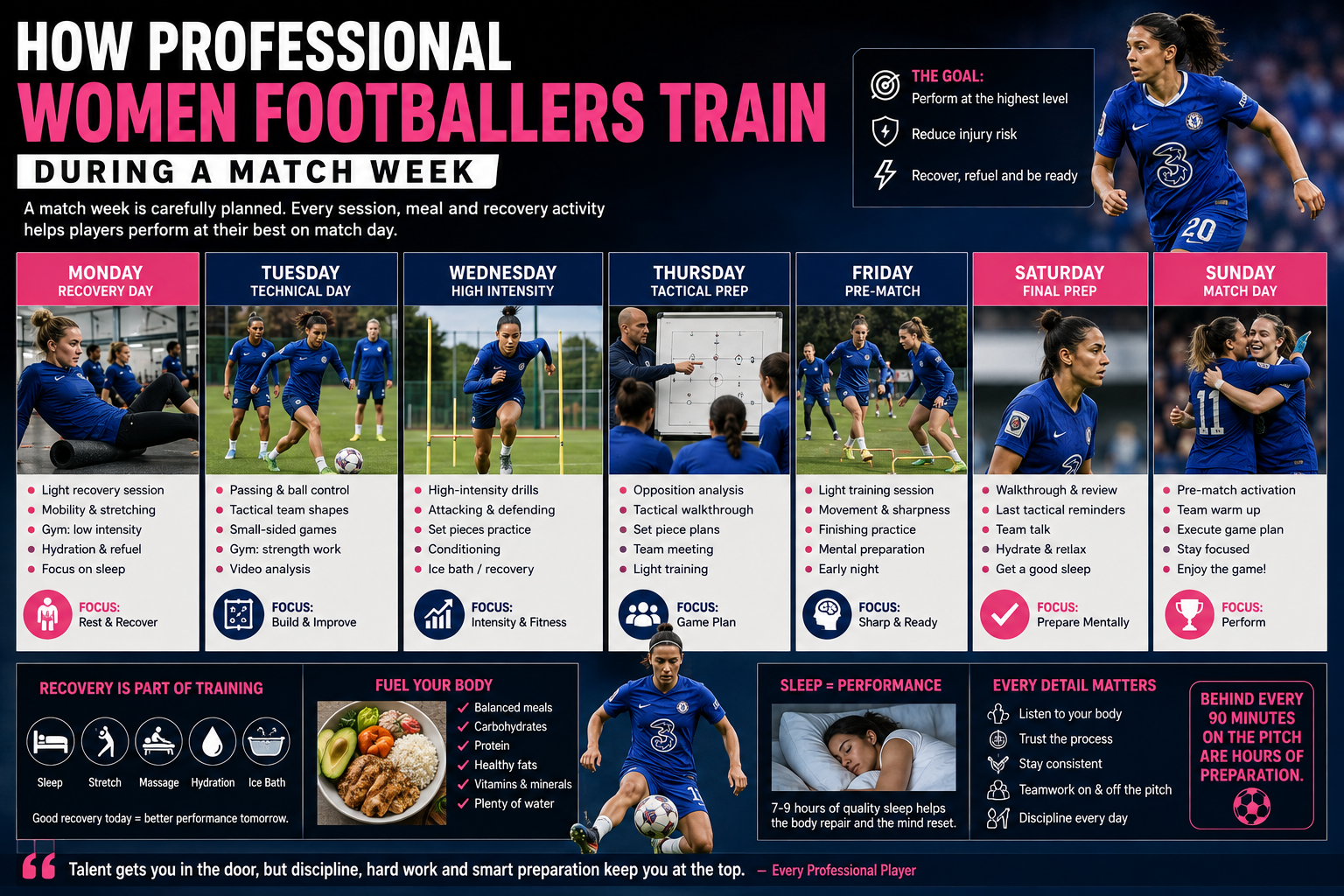
How Professional Women Footballers Train During a Match Week
Ever wondered how professional women footballers train? Learn what players do during a match week, including training, recovery, nutrition, sleep and preparation.
What Does a Professional Football Week Look Like?
There is no single training schedule used by every women's football club.
A team playing once during the week may have several training days. A team playing twice may have much less time for hard training because recovery becomes more important.
A simple match-week plan might look like:
Match day: Competition
Day after: Recovery
Two days after: Technical and tactical training
Three days after: Higher-intensity training
Day before match: Light preparation
Match day: Competition
The schedule changes depending on how many minutes each player played in the previous game.
FIFA's current female health and performance work focuses on areas such as recovery, sleep, nutrition, strength and conditioning, injury prevention and female-specific health.
What Happens After a Match?
The work does not stop when the final whistle blows.
Players begin recovery as soon as possible.
Depending on the club, this can include:
Rehydration
Food or recovery drinks
Light movement
Stretching
Medical checks
Massage or other recovery methods
Sleep and rest
The goal is to help the body prepare for the next training session or match.
FIFA notes that nutrition and hydration are important parts of recovery, while sleep should also be treated as a key part of performance.
Why Is Recovery So Important?
A professional footballer can play several matches in a short period.
That can put a lot of stress on the body.
FIFPRO research has linked match congestion with increased injury concerns in elite women's football, particularly when players have less time between matches. The organisation has also recommended additional recovery for players dealing with heavy travel and jet lag.
This is one reason coaches cannot simply make players train hard every day.
Sometimes rest is part of the training plan.
How Do Footballers Train on the Pitch?
Training sessions can cover many different areas.
Passing and Ball Control
Players work on keeping possession, passing under pressure and making quick decisions.
These exercises help footballers become comfortable with the ball even when opponents are close.
Finishing
Forwards and midfielders may spend time practising shots, one-on-one situations and finishing from different positions.
Defenders can also work on attacking set pieces.
Tactical Training
This is where players learn how the team wants to play.
They may practise:
Pressing
Defending
Building attacks
Counter-attacking
Set pieces
Moving into space
Responding to different opponents
The goal is to make the team's plan easier to follow during a real match.
Do Women Footballers Lift Weights?
Yes.
Strength and conditioning can be an important part of professional women's football.
Players may use gym sessions to improve strength, power and physical preparation. But the amount and type of gym work depends on the individual player and where the team is in its match schedule.
FIFA says an effective strength and conditioning programme should be individualised and take factors such as training age, skill level, strength weaknesses, injury history and other female-specific considerations into account.
This means two players on the same team may not receive exactly the same programme.
How Do Players Prepare for the Next Match?
As match day gets closer, training usually becomes more focused.
The team may spend more time working on the opponent's style.
For example, coaches may prepare players for:
The opponent's attacking threats
Defensive weaknesses
Set pieces
Pressing strategy
Expected formations
Specific player matchups
Training can also become lighter as the match approaches.
The aim is to help players arrive at the stadium feeling fresh rather than exhausted.
What Do Women Footballers Eat?
Nutrition is another major part of professional football.
Players need enough energy to train, compete and recover.
FIFA's football nutrition guidance says players should have an individual nutrition plan and pay attention to adequate energy, carbohydrates, protein, fats and fluids. It also highlights calcium and iron as important nutrients for female players.
A player's food choices can therefore change depending on whether she has:
A training session
A match
A recovery day
A long journey
Several matches close together
Professional clubs may have nutritionists who help players plan their meals.
Why Hydration Matters
Footballers lose fluid through sweat during training and matches.
That is why hydration is carefully considered.
Players may drink fluids before, during and after training or matches according to their individual needs.
FIFA's female health guidance lists nutrition and hydration as key parts of helping players perform and recover effectively.
Players also have different hydration needs, so one amount of water is not necessarily right for everyone.
How Important Is Sleep?
Sleep is not simply free time for professional footballers.
It is part of their recovery.
FIFA recommends that players develop consistent bedtime routines and identifies sleep as an important area for supporting recovery and performance.
Travel can make this harder.
A player who crosses several time zones may have to manage jet lag while preparing for another match.
That is why clubs may pay close attention to travel plans, rest periods and individual recovery.
What About Female-Specific Training
This is an area receiving more attention in women's football.
FIFA's 2026 Female Health and Performance Project covers topics including female physiology, menstrual health, pregnancy, postpartum health, nutrition, recovery, sleep, strength and conditioning, screening and injury prevention.
The important point is that female footballers should not simply be treated as smaller versions of male players.
Their training and support should take individual needs into account.
FIFA says strength and conditioning programmes should consider factors such as menstrual status and injury history when appropriate.
How Do Coaches Know When a Player Needs Rest?
Professional clubs can collect information about players throughout the week.
This can include training workload, match minutes, physical tests and how a player reports feeling.
FIFA previously described women's national-team performance staff using wellness information, hydration checks and GPS monitoring to help guide training decisions.
If a player is very tired or has soreness, the coaching and medical teams may adjust her workload.
This is important because the same training session may affect two players differently.
What Happens During a Busy Schedule?
The hardest weeks can involve several matches.
A player might have a league game followed by a cup match and then another league game within a short period.
In these situations, recovery becomes even more important.
FIFPRO has raised concerns about overloaded schedules in women's football, while FIFA's 2026–2029 international calendar was designed partly to give players more opportunities to rest, recover and retrain.
Some players may also be rotated to reduce their workload.
Do Players Train Every Day?
Not necessarily.
Professional footballers can train frequently, but the intensity changes.
A day may involve:
Hard physical training
Tactical work
Light technical work
Recovery
Gym work
Individual training
Rest
The aim is not to make players tired.
The aim is to make them ready to perform.
A Simple Example of a Match Week
Imagine a team plays on Sunday.
Monday — Recovery
Players recover from the match. Those who played many minutes may have a lighter programme.
Tuesday — Training
The team returns to more normal football work, including technical and tactical exercises.
Wednesday — High-Intensity Work
This may be one of the harder training days, depending on the team's schedule.
Thursday — Tactical Preparation
The team focuses more closely on the next opponent and its game plan.
Friday — Match Preparation
Training may become shorter and more focused.
Saturday — Final Preparation
Players complete a lighter session, review tactics and prepare mentally for the match.
Sunday — Match Day
The team competes.
This is only an example. Real schedules differ between clubs and players.
What Can Young Footballers Learn From Professionals?
Young players do not need expensive equipment or a professional club to learn from elite footballers.
The biggest lessons are simple:
Consistency matters. Training regularly is more useful than training extremely hard once in a while.
Recovery matters. Rest allows the body to prepare for the next session.
Food matters. Young athletes need enough nutritious food to support growth and sport.
Sleep matters. Good sleep should be part of an athlete's routine.
Individual needs matter. A training plan should be suitable for the player's age, experience and physical condition.
Young athletes should also work with qualified coaches and health professionals when planning serious training programmes.
The Real Secret Behind Professional Women's Football
There is no single secret training exercise that turns someone into a professional footballer.
The reality is a combination of many things:
Training, recovery, nutrition, sleep, tactical preparation, medical support and consistency.
The best players also spend years developing their technical skills and learning how to make good decisions under pressure.
Professional football is therefore not just about what happens during the 90 minutes.
Much of the work happens before and after the match.
When fans watch a professional women's football match, they see 90 minutes of competition.
What they do not always see is everything that happens around those 90 minutes.
Players train, recover, eat, sleep, study opponents and work with coaches and medical teams to prepare for the next challenge.
As women's football continues to grow, FIFA and other football organisations are also paying greater attention to female-specific health and performance research.
For aspiring footballers, the biggest lesson is simple: becoming a professional is not only about training harder. It is about learning how to train, recover and take care of your body intelligently.