
How to Start Playing Women’s Football: Beginner’s Guide for Girls and Women
Want to start playing women’s football? Learn how to find a team, choose the right position, improve your skills, train safely and begin your football journey.
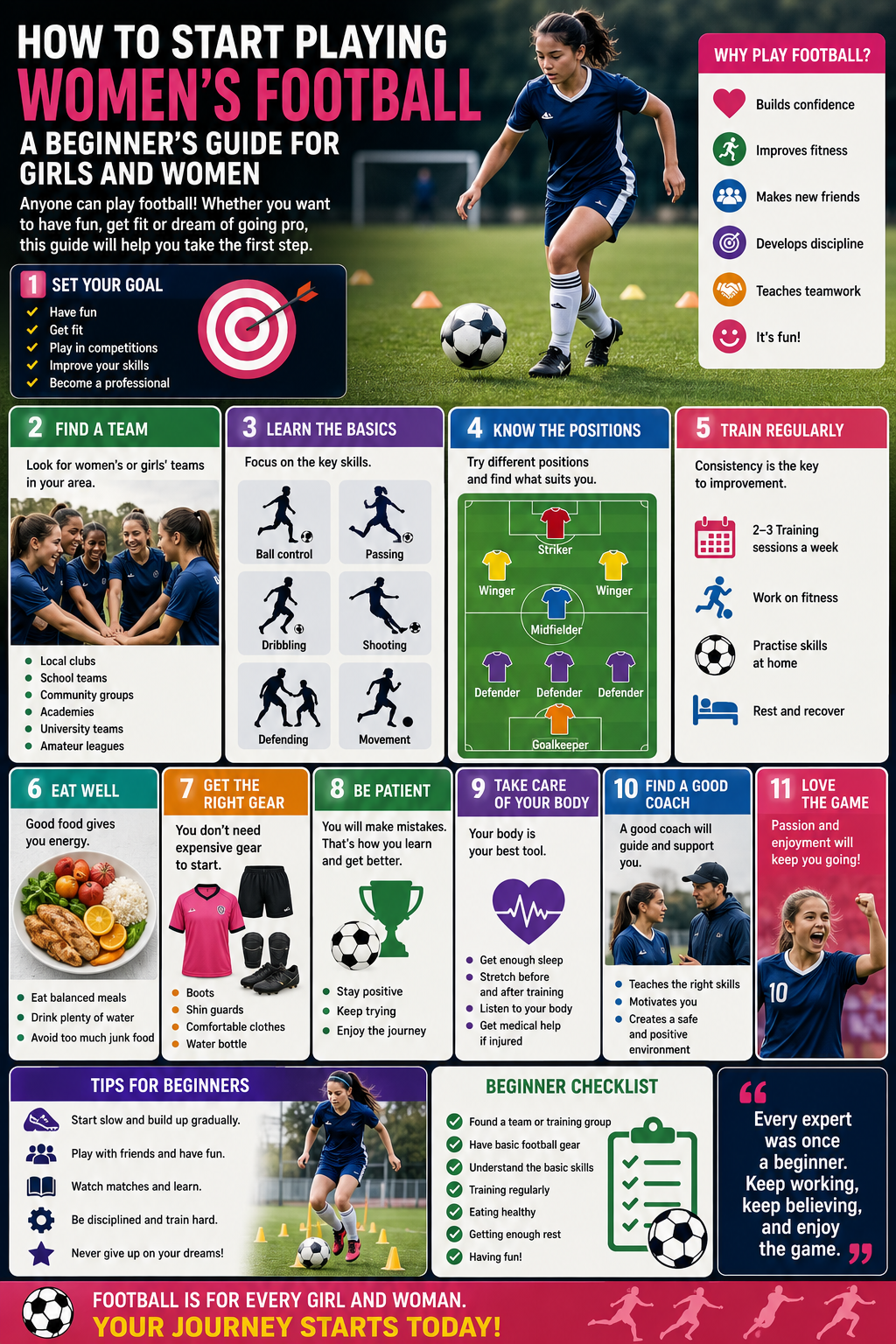
Start by Finding a Local Team
The first step is simple: find somewhere to play.
Look for:
Women’s football clubs
Girls’ football teams
Local academies
School teams
University teams
Community football groups
Amateur leagues
Grassroots football programmes
You do not need to join the biggest club in your area.
A friendly team where you can train regularly may be a better place to start.
FIFA's Women's Football Campaign supports grassroots and small-sided football activities designed to give girls and women opportunities to play, have fun and become involved in the sport.
Choose Your Goal
Before you start, think about what you want from football.
Your goal could be:
Fun: You simply want to enjoy the game and meet people.
Fitness: You want football to help you become more active.
Competition: You want to play matches and compete.
Career: You dream of becoming a professional footballer.
Development: You want to improve your skills and see how far you can go.
There is no wrong answer.
Knowing your goal can help you choose the right team and training level.
You Don't Need to Be Perfect
One of the biggest mistakes beginners make is thinking they need to be good before joining a team.
You don't.
Every footballer starts somewhere.
Your first training session may feel difficult. You may lose the ball, miss a shot or struggle to keep up.
That is normal.
The purpose of training is to improve.
A good coach should help you understand the basics and gradually become more confident.
Learn the Basic Football Skills
You don't need complicated skills when you are starting.
Focus on the basics first.
Ball Control
Learn how to receive the ball and keep it close to your feet.
Passing
Practise passing accurately with both feet.
Dribbling
Learn how to move with the ball while keeping control.
Shooting
Practise striking the ball with control and accuracy.
Defending
Learn how to stay between your opponent and the goal.
Movement
Learn where to move when you have the ball and when you don't.
Strong basic skills can give you a better foundation than trying to learn fancy tricks too early.
Find Your Position
You do not have to decide your permanent position immediately.
Try different roles.
Goalkeeper
The goalkeeper protects the goal and can use her hands inside the penalty area.
Defender
Defenders help stop the opposition from creating chances.
Midfielder
Midfielders connect defence and attack and often cover a lot of ground.
Winger
Wingers usually play wide and help create attacking opportunities.
Striker
Strikers are often responsible for creating and finishing scoring chances.
Your position may change as you develop.
A coach can help you find the role that suits your skills and physical strengths.
Train Regularly
You don't need to train for several hours every day.
Consistency is more important.
For a beginner, a simple week could include:
Two football training sessions
One light fitness session
One personal ball-skills session
At least one full rest day
The exact amount should depend on your age, fitness level and other activities.
If you are young, your training should be suitable for your age and development.
Practise at Home
You can improve some football skills without having a full football pitch.
You could practise:
Passing against a safe wall
Ball touches
Dribbling around cones
First touch
Weak-foot passing
Shooting into a safe target
Simple footwork
Even 15–30 minutes of focused practice can help when done regularly.
The goal is not to train until you are exhausted.
The goal is to improve one skill at a time.
Improve Your Fitness Slowly
Football involves running, changing direction, stopping, accelerating and recovering.
But beginners should not suddenly start doing very hard workouts.
Build your fitness gradually.
Start with activities such as:
Walking
Light jogging
Short runs
Bodyweight exercises
Simple strength exercises
Football drills
If you are returning to exercise after a long break or have a health concern, speak with an appropriate health professional before starting a demanding programme.
Don't Forget Strength Training
Strength can help footballers with movement, balance and physical control.
Simple exercises can include:
Squats
Lunges
Glute bridges
Calf raises
Push-ups
Core exercises
The exercises should be appropriate for your age and experience.
For young players especially, proper technique and qualified coaching are more important than lifting heavy weights.
FIFA's women’s football development work also places emphasis on coach education and elite performance, showing how structured training is becoming an important part of the women's game.
Take Recovery Seriously
Beginners sometimes think more training always means faster improvement.
That is not true.
Your body needs time to recover.
Rest can help you return to training feeling ready rather than exhausted.
Pay attention to:
Sleep
Rest days
Food
Fluids
Muscle soreness
General tiredness
If you have ongoing pain or an injury, do not simply try to play through it.
Get appropriate medical advice.
Eat Enough to Support Training
Football requires energy.
Young players especially need enough food to support both growth and sport.
A balanced diet can include foods such as:
Rice
Potatoes
Pasta
Bread
Fruits
Vegetables
Eggs
Fish
Meat
Beans
Milk or other suitable dairy foods
The right diet depends on the individual.
If you are training seriously, a qualified sports nutrition professional can help you understand your specific needs.
Get the Right Equipment
You do not need expensive equipment when starting.
The basics may include:
Football boots suitable for your playing surface
Shin guards
Comfortable sports clothing
Football socks
Water bottle
Training ball
If you play on artificial turf, grass or another surface, make sure your footwear is designed for it.
Good equipment does not make someone a better footballer, but the right equipment can help you train safely and comfortably.
Learn From Every Training Session
Don't judge yourself only by goals or assists.
Ask yourself:
Did my passing improve?
Was my first touch better?
Did I make good decisions?
Did I understand the coach's instructions?
Did I work hard for my teammates?
What mistake can I learn from?
Improvement is not always obvious after one training session.
Sometimes you notice the difference after several weeks.
Don't Be Afraid of Mistakes
Football is a game of mistakes.
Even the best players lose the ball.
They miss chances.
They make the wrong pass.
They sometimes make poor decisions.
What matters is what happens next.
If you make a mistake, recover and continue playing.
Confidence grows when you learn that one mistake does not define your entire performance.
Find a Good Coach
A good coach can make a huge difference.
Look for someone who:
Teaches clearly
Treats players with respect
Encourages learning
Takes safety seriously
Gives useful feedback
Creates a positive environment
Helps players develop
For young girls, a safe and supportive environment is especially important.
FIFA's league-development programme focuses on helping create structured environments where players, coaches and referees can develop and enjoy the game.
Don't Compare Your Beginning to Someone Else's Middle
You may join a team and see another girl who has been playing since she was five.
Don't compare yourself with her.
She has years of experience that you don't have yet.
Instead, compare yourself with your previous version.
If your first touch is better than it was three months ago, you are improving.
If you can use your weaker foot more confidently, you are improving.
If you understand the game better, you are improving.
Can You Become a Professional Footballer?
Yes, it is possible to aim for professional football, but it is highly competitive.
The pathway can include:
Grassroots - Academy - Youth team - Senior club - Professional football
The exact pathway differs between countries.
FIFA is working with member associations to develop youth leagues, academies, competitions and other pathways for girls and women.
If you have professional ambitions, start by finding the strongest appropriate level available to you and continue developing.
What If You Start Late?
Starting late does not mean you cannot enjoy football.
You may not have the same development pathway as someone who started at six, but you can still:
Join an amateur team
Play recreational football
Enter local competitions
Improve your fitness
Learn technical skills
Become a goalkeeper
Coach later
Referee
Work in football administration
Football has opportunities beyond becoming a professional player.
Encourage Other Girls to Play
One of the best ways to grow women's football is simply to get more girls involved.
Invite a friend to training.
Support your local women's team.
Watch women's football.
Share women's football stories.
Encourage young girls who are interested in the sport.
FIFA's current development goal is to reach 60 million female players globally by 2027, and its grassroots programmes are designed to bring more girls and women into football.
Every new player adds to the future of the game.
A Simple Beginner's Football Plan
If you are starting this month, try this simple approach:
Week 1: Find a local team and attend your first training session.
Week 2: Work on passing, ball control and basic fitness.
Week 3: Add short personal training sessions.
Week 4: Play your first friendly or small-sided game if your coach says you are ready.
After one month, look back and identify three things you have improved.
Then keep going.
Frequently Asked Questions
Can girls start playing football at any age?
Yes. The best starting point depends on age, goals and local opportunities. Young players can look for age-group teams, while adults can explore women's or recreational teams.
Do I need to be fit before joining a football team?
No. Training can help you improve your fitness. Start at a level that matches your current ability.
What position should a beginner play?
There is no single best position. Try different roles and allow your coach to help you find one that suits you.
Can I become a professional if I start late?
It is more difficult because professional players often begin structured development at a young age, but starting late should not stop you from improving or enjoying the game.
Is women's football growing?
Yes. FIFA currently has development programmes covering grassroots participation, league development, coaching, club licensing and other areas, with all 211 member associations eligible to apply for support.
Starting women's football does not have to be complicated.
Find a safe place to play, get a good coach, learn the basics and practise regularly.
Most importantly, enjoy the game.
You do not need to be the best player on your first day. You only need to be willing to learn.
Women's football is creating more opportunities around the world, and the next generation of players will be an important part of that growth.