The 10-Second Countdown That Cost Iceland the Match: Football’s New Substitution Rule Claims Its First Victim
No More Time wasting: How FIFA’s Brutal New Anti-Time-Wasting Law Handed Japan a Dramatic Win Over Iceland
Football’s lawmakers just turned one of the oldest, most irritating dark arts of the game into a high-stakes gamble. For decades, players being subbed off late in a match have treated the walk to the touchline like a leisurely Sunday stroll. But a brand-new regulation has officially turned the "slow substitution" from a harmless tactical ploy into a self-inflicted tactical disaster—and Iceland just learned that lesson the hard way.
In a recent international friendly against Japan in Tokyo, Iceland became the first nation to fall foul of FIFA’s revamped substitution laws ahead of the 2026 World Cup. The consequence? They were forced to play a man down, and Japan capitalized instantly to score the winning goal.
Here is how a few extra seconds of walking completely altered the scoreboard.
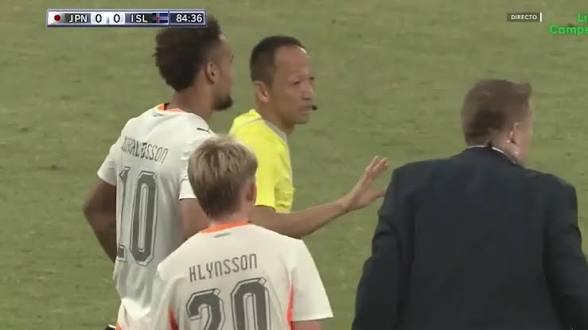
The match between Japan and Iceland was locked in a tight battle. In the 85th minute, Iceland executed a double substitution. The first switch went smoothly, but the second turned into total chaos.
Iceland’s Kristian Nökkvi Hlynsson was signaled to leave the pitch. Instead of rushing to the nearest touchline, Hlynsson took his time. By the time he crossed the white line, the 10-second countdown had expired.
The referee promptly held up his hand, stopping Hlynsson’s replacement, Ísak Snær Thorvaldsson, from entering the field. Iceland were suddenly down to 10 men, and the clock was ticking.
Iceland’s numerical disadvantage lasted for one minute and 51 seconds before a stoppage finally arrived. Unfortunately for them, that stoppage was the ball hitting the back of their own net. Utilizing the extra space, Japan pushed forward, and striker Koki Ogawa headed home the game's only goal in the 87th minute.
The Crime and the Punishment: What is the New Rule?
Approved by the International Football Association Board (IFAB) to curb rampant time-wasting and improve match tempo, the Timed Substitution Rule is brutally simple:
• The 10-Second Limit: Once the substitution board goes up, the player exiting the field has exactly 10 seconds to clear the pitch, and they must exit via the nearest point on the boundary line.
• The One-Minute Penalty: If the player fails to leave within the 10-second window, the incoming substitute is blocked from entering the field immediately.
• The Catch: The substitute must wait on the sidelines until the first natural stoppage in play after a full minute has elapsed.
Note: Because the replacement player can only enter at the first stoppage after that 60-second window, a team could easily find themselves playing with 10 men for two, three, or four minutes if the ball stays in play.
The Global Crackdown on Time-Wasting.
If you think this rule feels incredibly harsh, get used to it.
This regulation, which was successfully trialed in Major League Soccer (MLS) before being adopted globally, is part of a massive FIFA crackdown on gamesmanship ahead of the 2026 World Cup.
Iceland's nightmare is a warning shot to every manager and player on the planet.
For years, fans have complained about the closing minutes of football matches turning into a stop-start farce. FIFA’s response is loud and clear: if you try to steal time, we will take your players.
What used to cost a player a meaningless yellow card in the 91st minute now costs their team a literal goal. Iceland’s mishap has provided a brutal blueprint of what not to do. As we head into a major tournament summer, expect to see managers screaming at their players to sprint off the pitch—because nobody wants to be the next team left defending a World Cup dream with 10 men.