
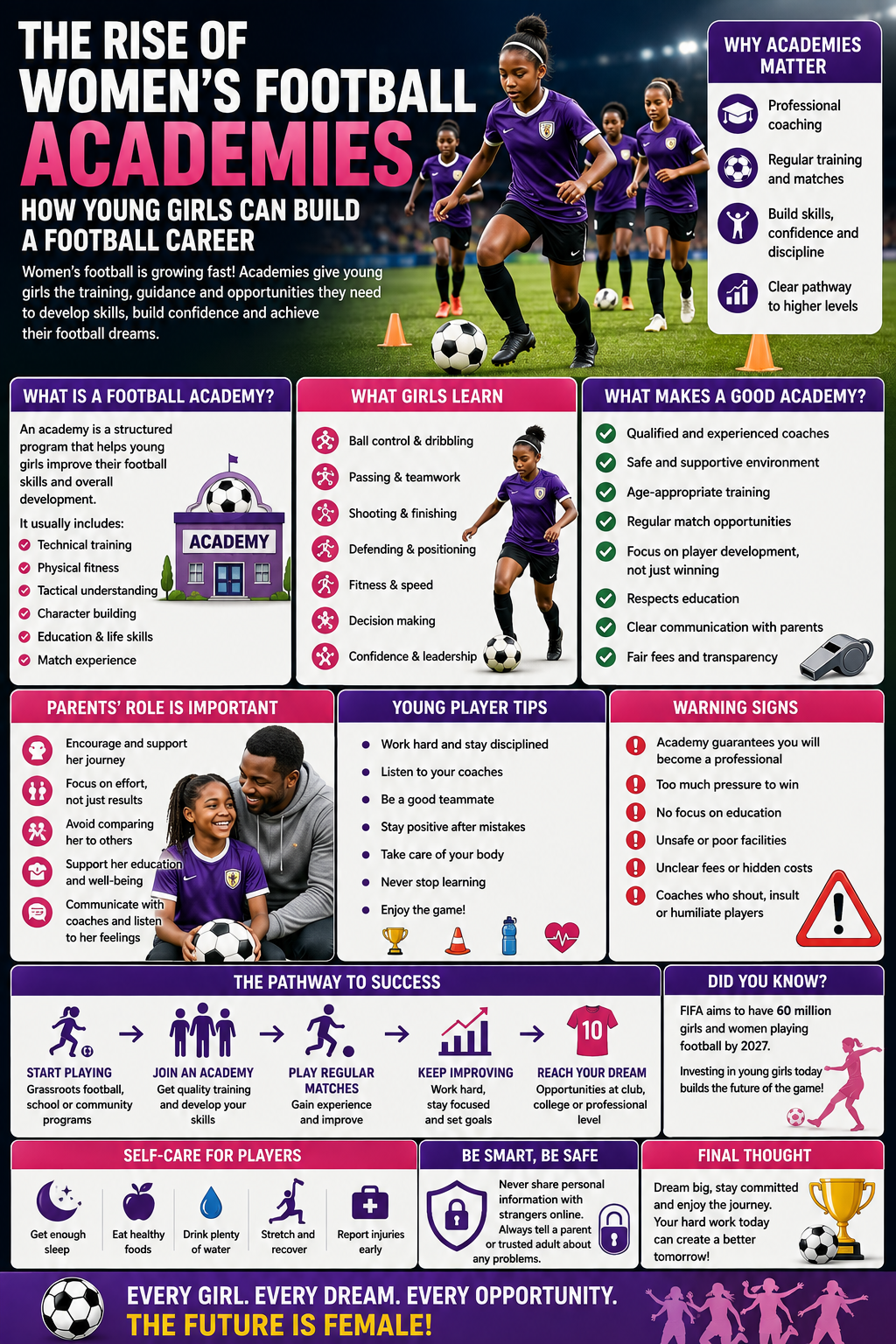
Women’s Football Academies: How Young Girls Can Start a Football Career
Learn how women’s football academies help young girls develop skills, confidence and match experience, and what parents should look for before choosing an academy.
What Is a Women's Football Academy?
A football academy is a programme or organisation designed to develop young players.
Players normally train according to their age and ability.
Training can include:
Ball control
Passing
Shooting
Dribbling
Defending
Speed and movement
Fitness
Teamwork
Decision-making
Match play
A good academy should focus on developing the whole player, not just winning matches.
Why Are Academies Important for Girls?
Young girls need regular opportunities to play and improve.
An academy can give them access to:
Qualified coaches
Regular training
Competitive matches
Other young players
Better football education
A clear development pathway
This can be especially important in places where girls have fewer opportunities to play football.
FIFA has continued to support women's football development programmes that focus on grassroots participation, youth development, coaching and stronger pathways for girls and women.
Starting Young Can Help, But It Is Not Everything
Many professional footballers started playing at a young age.
Starting early gives a player more time to develop her technical skills and understanding of the game.
But starting young does not guarantee a professional career.
Talent, hard work, coaching, health, opportunities, education and many other factors matter.
A girl who starts later can still enjoy football and develop into a strong player.
The most important thing is having an environment where she can learn and enjoy the sport.
What Should Young Players Learn?
A good academy should teach more than tricks.
Ball Control
Players should learn how to receive and control the ball under pressure.
Passing
Accurate passing with both feet is an important foundation.
Dribbling
Players should learn when to dribble and when passing is the better option.
Shooting
Young players should learn different ways to strike the ball.
Defending
Every player should understand basic defending, not only defenders.
Decision-Making
Football is not just about physical ability.
Players need to learn when to pass, shoot, dribble, move or defend.
Why Match Experience Matters
Training is important, but players also need to play matches.
Games teach young footballers things that training drills cannot always reproduce.
A match helps players learn:
How to handle pressure
How to communicate
How to make quick decisions
How to deal with mistakes
How to work with teammates
How to compete fairly
An academy that only trains players but rarely gives them suitable match opportunities may not provide a complete development experience.
What Makes a Good Women's Football Academy?
Before joining an academy, parents should ask questions.
1. Are the Coaches Qualified?
Ask about the coaches' qualifications and experience.
2. Is Player Safety Taken Seriously?
The academy should have clear procedures for injuries, emergencies and safeguarding.
3. Are Training Sessions Age-Appropriate?
A programme designed for teenagers may not be suitable for younger children.
4. Do Players Get Match Opportunities?
Ask how often the team plays competitive or friendly matches.
5. Is Education Respected?
Young players should not be encouraged to abandon education simply because they dream of becoming footballers.
6. Are Parents Given Clear Information?
Fees, schedules, travel plans and other important details should be explained clearly.
Be Careful With Academies Promising Professional Contracts
Parents should be careful when an academy promises that a child will become a professional footballer.
Nobody can guarantee a professional career.
A genuine academy should talk about development, not guaranteed success.
Be cautious if someone says:
"Pay this money and your daughter will become a professional player."
Football development does not work that way.
There are many talented players, and only a small percentage eventually reach the highest professional levels.
How Much Should a Football Academy Cost?
There is no single correct price.
Fees depend on the country, academy, facilities, coaching and services provided.
Before paying, ask exactly what the fee covers.
It may include:
Training
Coaching
Kits
Matches
Transport
Tournament fees
Facility use
Parents should also ask whether there are additional costs.
A cheap academy is not automatically bad, and an expensive academy is not automatically good.
Focus on the quality and safety of the programme.
Should Girls Only Train With Other Girls?
Not necessarily.
Girls can benefit from different training environments depending on their age and development.
Some programmes are girls-only.
Others may include mixed training at younger ages.
The most important things are:
Safety
Appropriate competition
Good coaching
Regular playing opportunities
A positive environment
The Importance of Female Coaches
Female coaches can be valuable role models for young girls.
Seeing women working as:
Coaches
Referees
Team managers
Fitness trainers
Football directors
can help young players understand that football can offer many career opportunities.
FIFA has also increased its focus on women's involvement in coaching and other football roles as part of the wider development of the women's game.
Parents Have an Important Role
Parents can help young players without putting too much pressure on them.
Encourage Her
Let her know that you are proud of her effort, not only her goals.
Let Her Make Mistakes
Mistakes are part of learning.
Avoid Comparing Her With Other Players
Every player develops at a different speed.
Support Her Education
Football is important, but education should also remain part of her development.
Listen to Her
If she no longer enjoys the academy, find out why.
Football should not become a source of constant fear or pressure.
Don't Make Winning the Only Goal
A young team can lose a match and still have a successful development programme.
Ask:
Did the players improve?
Did they learn something?
Did they enjoy the game?
Did they show teamwork?
Did they become more confident?
These things can be more important than the result.
How Can a Young Player Stand Out?
Young players often think they need to score lots of goals to impress coaches.
Not always.
Coaches may also notice players who:
Work hard
Listen
Arrive on time
Respect teammates
Defend
Communicate
Make good decisions
Accept feedback
Stay positive after mistakes
Football intelligence and attitude can be just as important as natural talent.
What About Social Media?
Social media can help young players discover opportunities.
Clubs and academies often share:
Trials
Training sessions
Tournaments
Team announcements
Player achievements
But young players and parents should be careful about sharing personal information online.
Never send private documents, financial information or sensitive personal details to an unknown person simply because they claim to represent a football academy.
What Should Happen at a Football Trial?
A trial allows coaches to watch a player before deciding whether she is suitable for a team.
A trial may include:
Warm-up
Ball drills
Small-sided games
Passing exercises
Shooting
Full matches
Fitness activities
A player does not need to be perfect.
Coaches may be looking at technical ability, decision-making, attitude and potential.
What If a Player Is Not Selected?
Being rejected by an academy does not mean a player is not talented.
She may simply need more development.
Ask the coach:
"What should I improve?"
Then work on those areas and try again later.
Many successful footballers faced setbacks during their careers.
One rejection should not end a player's football journey.
A Simple Development Plan for a Young Player
A beginner could focus on:
Monday: Rest or light activity
Tuesday: Team training
Wednesday: Ball skills for 20–30 minutes
Thursday: Team training
Friday: Rest
Saturday: Match or small-sided game
Sunday: Recovery and family time
The exact schedule should be adjusted for the player's age, school commitments, fitness and the advice of qualified coaches.
Young athletes should not copy the training schedule of adult professionals.
What Does the Future Look Like?
The future of women's football depends heavily on developing the next generation.
More girls playing today means a larger pool of players for tomorrow's clubs and national teams.
FIFA's development programmes include support for grassroots football, leagues and youth pathways, while CAF has also reported growth in registered female players and women's football structures across Africa.
That means academies can become an important bridge between grassroots football and professional football.
Frequently Asked Questions
What age should a girl start football?
There is no single perfect age. Girls can start playing at different ages through schools, community programmes, grassroots teams and academies.
Does joining an academy guarantee a professional career?
No. A good academy develops players, but nobody can guarantee that a young player will become a professional.
What should parents look for in an academy?
Look for qualified coaches, safe facilities, age-appropriate training, regular matches, clear fees, good communication and a positive environment.
Should young girls focus only on football?
No. Education, friendships, family life and general development are also important.
Can a girl become a professional footballer if she starts late?
It can be more difficult, but starting late should not stop someone from enjoying football or trying to improve.
Football academies can give young girls something very valuable: an opportunity to learn and develop.
The goal should not be to turn every child into a professional footballer.
The goal should be to help girls become better players, build confidence, stay active and enjoy the game.
For the few who eventually reach professional football, a strong academy can provide an important foundation.
For everyone else, the experience can still create lifelong memories and a lasting love for football.