
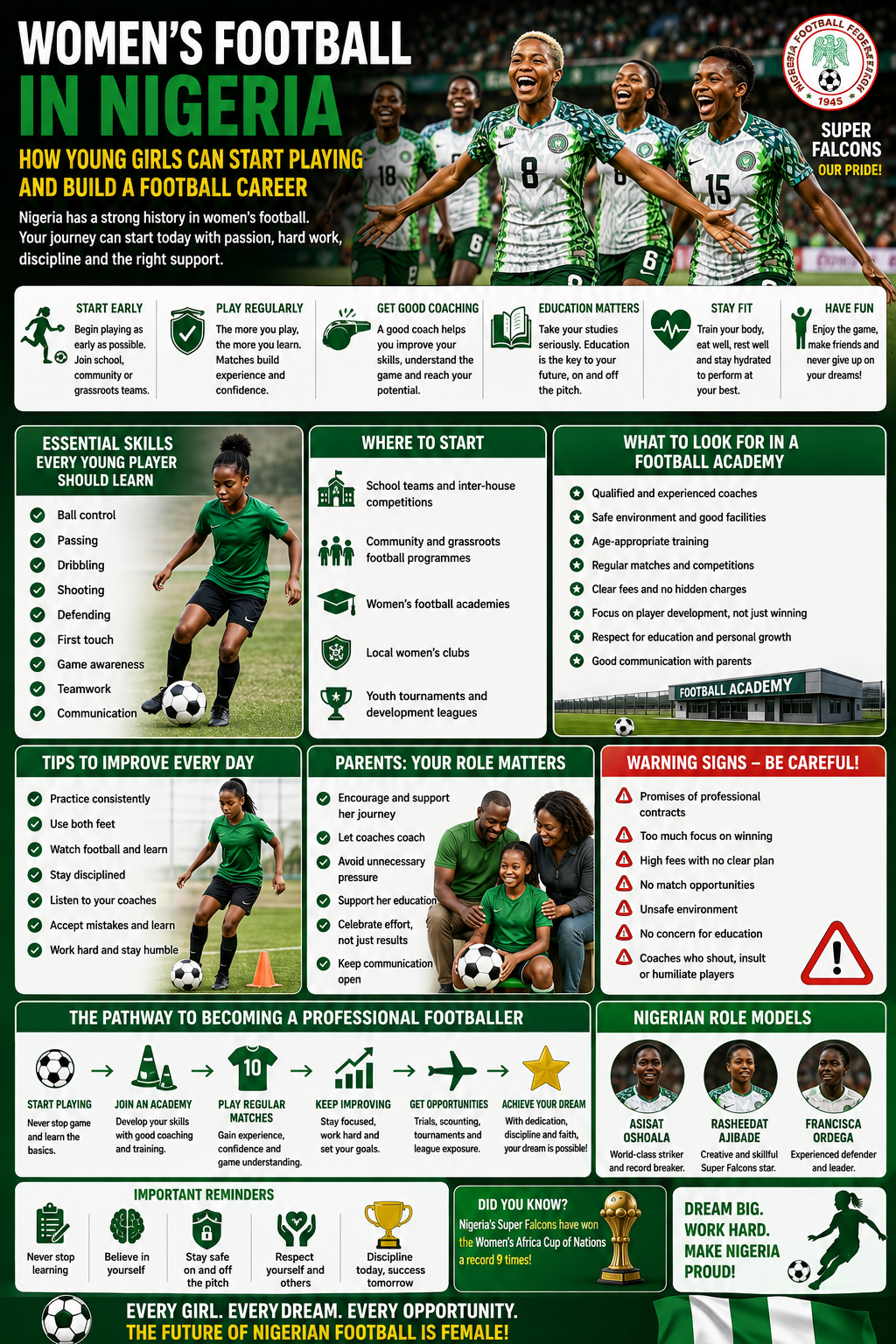
Women’s Football in Nigeria: How Girls Can Start a Football Career
Learn how girls in Nigeria can start playing football, find academies, join clubs, improve their skills and build a pathway toward professional women’s football.
Start Playing as Early as Possible
A young girl does not need expensive equipment or a famous academy to start.
She can begin by playing with:
School teams
Community teams
Local women's football clubs
Grassroots programmes
Football academies
Youth competitions
The most important thing at the beginning is playing regularly.
The more a young player touches the ball and experiences real games, the more opportunities she has to learn.
Look for a Safe Football Academy
A good academy should focus on player development.
Before paying any fees, parents should find out:
Who are the coaches?
Where does training take place?
How often do players train?
Do players play regular matches?
What age groups are accepted?
What does the fee cover?
Are there additional costs?
How are injuries handled?
What safeguarding measures are in place?
Be careful with anyone who promises that paying a certain amount of money will automatically make a child a professional footballer.
No legitimate academy can guarantee a professional career.
School Football Can Be a Good Starting Point
Girls should not ignore school football.
School competitions can provide young players with their first experience of organised football.
They can also help coaches identify talented players who may later move into academies or clubs.
For parents, school football can be a good way to let a child discover whether she genuinely enjoys the sport before spending large amounts of money on training.
Learn the Basic Skills
Young Nigerian players should focus on the basics before trying to learn complicated tricks.
Important skills include:
Ball Control
Learn how to receive the ball comfortably with different parts of both feet.
Passing
Practise accurate short and long passes.
Dribbling
Learn to control the ball while moving and understand when dribbling is useful.
Shooting
Practise accuracy as well as power.
Defending
Learn how to mark opponents, tackle safely and protect space.
First Touch
A good first touch gives a player more time to make her next decision.
Use Both Feet
One simple way to improve is to practise with the weaker foot.
Many young players naturally prefer one foot.
That is normal.
But becoming comfortable with both feet can make a player more useful in different positions.
Start with simple exercises:
Five-minute passing practice
Ball touches
Short dribbling drills
Simple shooting
Passing against a wall
Consistency matters more than doing difficult tricks.
Play Matches, Not Just Training Drills
Training is important, but matches teach players how to use their skills under pressure.
Games help young players learn:
Decision-making
Positioning
Teamwork
Communication
Confidence
Game awareness
A player may look excellent during a simple training drill but struggle during a real match.
That is why match experience is so important.
Find the Right Position
Young players should not worry too much about choosing one permanent position.
They can try:
Goalkeeper
Centre-back
Full-back
Midfielder
Winger
Striker
Playing different positions can help a young footballer understand the whole game.
A coach can later help identify the position that best suits her strengths.
Fitness Matters
Football requires more than technical skill.
Players need to run, stop, turn, jump and change direction repeatedly.
Young players should develop fitness gradually through age-appropriate activities.
Training can include:
Running
Agility exercises
Bodyweight strength exercises
Football drills
Balance work
Coordination exercises
Young athletes should not copy the intense training schedules of adult professional players.
Take Recovery Seriously
Rest is part of training.
A young player needs enough time to recover between demanding sessions.
Good habits include:
Getting enough sleep
Eating balanced meals
Drinking enough water
Taking rest days
Reporting injuries
Following the coach's recovery advice
A player should not feel pressured to hide an injury just because she wants to play.
Don't Ignore Education
One of the most important messages for young Nigerian footballers is this:
Take football seriously, but take your education seriously too.
A professional football career is never guaranteed.
Injuries, selection decisions, finances and many other factors can affect a player's career.
Education gives young players another path while they pursue their football dreams.
A good football programme should support a child's overall development rather than forcing her to choose between school and sport too early.
Follow Nigerian Women's Football
Young players should watch women's football whenever they can.
Watching experienced players can teach them about:
Movement
Positioning
Passing
Defending
Finishing
Decision-making
They can follow the Super Falcons, domestic women's competitions and Nigerian players competing internationally.
Watching football should not only be entertainment.
It can also become part of learning.
Learn From Nigerian Female Footballers
Young girls need role models.
Players such as Asisat Oshoala, Rasheedat Ajibade and other Nigerian stars have shown that Nigerian women can compete at high levels internationally.
Following successful players can help young girls see football as something they can take seriously.
But young players should remember that every professional footballer started as a beginner.
Understand That Talent Alone Is Not Enough
A naturally talented player still needs discipline.
Coaches often value players who:
Listen
Work hard
Arrive on time
Respect teammates
Accept criticism
Keep learning
Stay focused
Take care of their bodies
Being talented can get you noticed.
Your attitude can help determine how far you go.
Be Careful With Football Scams
This is particularly important for young players and their parents.
Be cautious if someone claims they can guarantee:
A professional contract
A national-team place
A European club contract
A trial with a famous club
in exchange for a large amount of money.
Before making payments, verify the organisation through official channels.
Do not send passports, bank details or other sensitive documents to strangers simply because they claim to be football agents or scouts.
What About Football Agents?
As a player becomes older and reaches a higher level, she may eventually work with an agent.
But young players and parents should understand that an agent should not be treated as a shortcut to becoming a professional.
Development comes first.
A player needs the ability to perform at the required level.
Parents should also verify an agent's identity, licence status where applicable and reputation before signing anything.
Can Nigerian Girls Become Professional Footballers?
Yes.
Nigeria has a strong history in women's football, and Nigerian players have competed at major international tournaments and in professional leagues abroad.
But the pathway is competitive.
A player may need to move through several stages:
School/grassroots football - Academy - Youth team - Local club - Professional club -International football
Not every player's journey will look exactly the same.
Some players may move abroad at a younger age, while others develop through domestic football first.
Why Women's Football Academies Matter
Academies can help create a bridge between grassroots football and professional clubs.
A strong academy can provide:
Regular coaching
Match experience
Fitness development
Tactical education
Player assessment
Mentorship
But the quality of academies varies.
Parents should research carefully before enrolling their children.
The Role of Parents
Parents can make a huge difference.
The best support does not mean shouting instructions throughout every match.
Instead:
Encourage effort.
Celebrate improvement.
Let coaches coach.
Listen to your child.
Support education.
Take injuries seriously.
A young girl should feel that football is something she enjoys, not something she must use to satisfy her parents.
What If She Is Not Selected?
Being rejected by a club or academy can hurt.
But it does not mean the player's football journey is over.
Ask the coach:
"What should she improve?"
Then work on those areas.
A player can try again later.
She can also look for another team where she may receive more playing time.
Sometimes development happens faster when a player gets regular minutes rather than sitting on the bench at a famous club.
How Social Media Can Help
Social media has become an important way for football clubs and academies to share information.
Players can use platforms to:
Follow clubs
Find trials
Watch training videos
Learn from professional players
Follow competitions
Build a football profile
But young players should use social media carefully.
Never share private information publicly.
Parents should also be involved when children are contacted by people claiming to be scouts or agents.
A Simple Weekly Plan for a Young Player
A beginner could use a simple schedule like this:
Monday: Rest
Tuesday: Team training
Wednesday: 20–30 minutes of ball skills
Thursday: Team training
Friday: Rest or light activity
Saturday: Match
Sunday: Recovery
The exact schedule should depend on age, schoolwork, fitness and the coach's advice.
More training is not always better.
What Should a Young Player Practise at Home?
A football does not require a huge field.
A safe space can be used for:
Ball touches
Passing against a wall
Dribbling
First touch
Weak-foot practice
Short shooting drills
Even 20 minutes of focused practice can be useful.
The goal is to improve gradually.
The Future of Women's Football in Nigeria
Nigeria has a strong football culture and a large pool of young talent.
The future of women's football will depend on how well that talent is developed.
Young girls need:
Better grassroots programmes
Stronger academies
Regular competitions
Good coaches
Safe facilities
Professional clubs
Better player protection
More media coverage
More investment
The success of the Super Falcons can inspire the next generation, but the domestic system must also give young players somewhere to develop.
Frequently Asked Questions
What age can a girl start football in Nigeria?
There is no single correct age. Girls can begin through schools, grassroots programmes, community teams and age-appropriate academies.
How can I find a women's football academy in Nigeria?
Start with local football associations, established clubs, schools and recognised football organisations. Always verify an academy before paying fees.
Can a girl become a professional footballer in Nigeria?
Yes. Nigerian women have built professional careers both in Nigeria and internationally. However, professional football is highly competitive and there is no guaranteed pathway.
Does a girl need expensive football boots to start?
No. Beginners can start with suitable, safe equipment. Good coaching and regular practice are more important than expensive brands.
Should parents pay someone who promises a professional contract?
Parents should be extremely careful. No one can guarantee that a child will become a professional footballer.
Nigeria has talented girls who dream of becoming footballers.
The challenge is making sure those dreams have a real pathway.
A young girl does not need to start with a big club.
She needs a ball, a safe place to play, good coaching, regular practice and people who believe in her without putting unhealthy pressure on her.
Start small. Learn the basics. Keep improving. Stay in school. Take care of your body. And never let one rejection convince you that your football journey is over.
The next Super Falcons star could be a girl who is playing football on a small field today.