
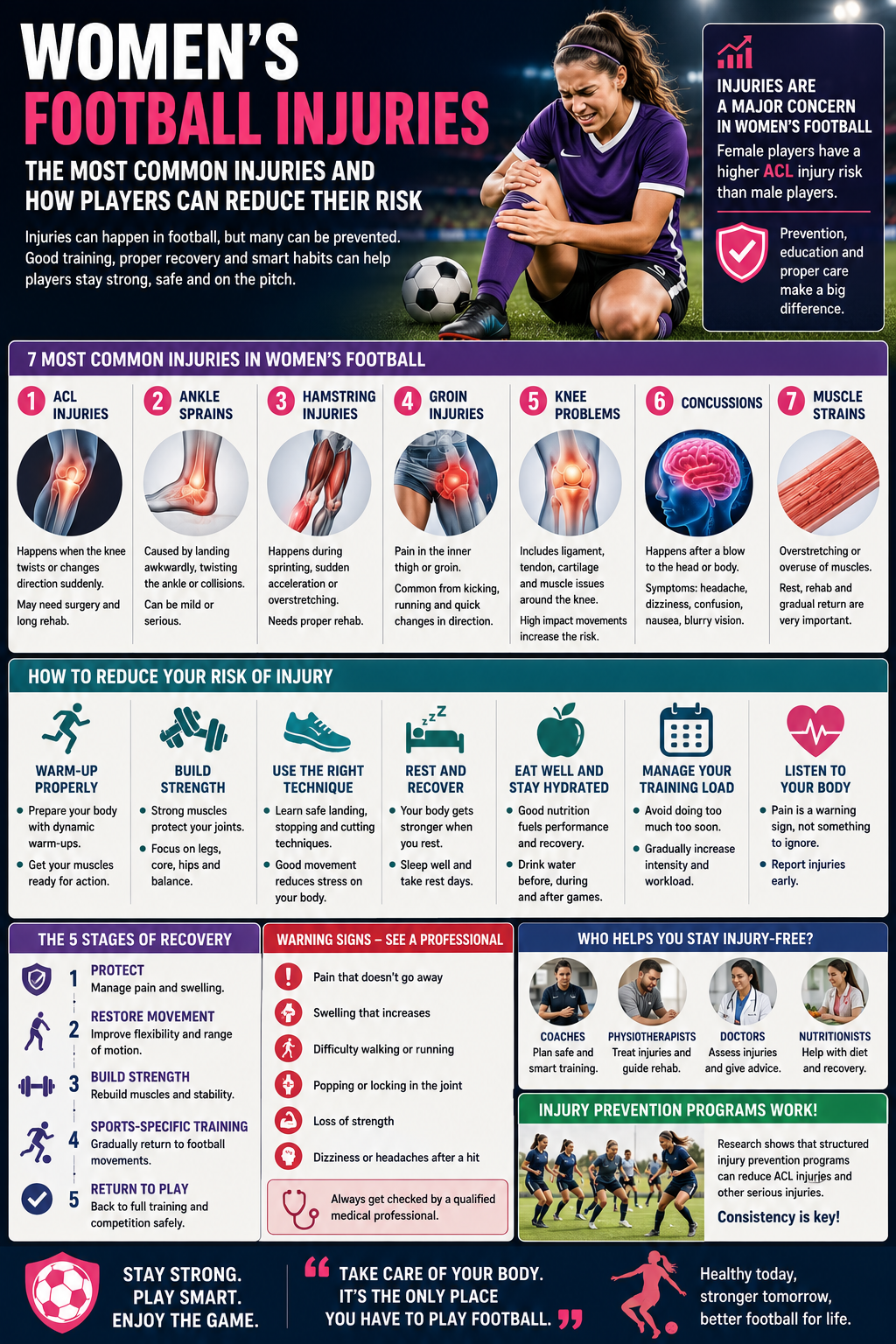
Women’s Football Injuries: Common Injuries, Causes and Prevention
Learn about common injuries in women’s football, including ACL injuries, ankle sprains, hamstring problems and how proper training can help reduce risk.
ACL Injuries
The anterior cruciate ligament, commonly called the ACL, is one of the major ligaments inside the knee.
An ACL injury can happen when a player suddenly:
Changes direction
Stops
Lands from a jump
Twists the knee
Collides with another player
ACL injuries are a major concern in women's football.
Research has found that female footballers have a higher ACL injury risk than male footballers, although the reasons are complex and involve biological, hormonal, neuromuscular, training, environmental and other factors.
A serious ACL injury can require surgery and a long rehabilitation period.
Ankle Sprains
Ankle sprains are common in football.
They can happen when a player:
Lands awkwardly
Steps on another player's foot
Changes direction quickly
Twists the ankle during a challenge
A mild sprain may heal relatively quickly, while a more serious injury can keep a player out for much longer.
Returning too soon can also increase the chance of another injury.
Hamstring Injuries
The hamstrings are muscles at the back of the thigh.
Football requires repeated sprinting, acceleration and sudden changes in speed, which can place stress on these muscles.
A hamstring injury may cause:
Sudden pain
Tightness
Difficulty running
Reduced strength
Players who suffer a hamstring problem should be assessed appropriately before returning to full training.
Groin Injuries
Groin problems can affect footballers because the sport involves kicking, sprinting and changing direction.
Pain may develop gradually or appear suddenly.
Ignoring groin pain can make the problem worse.
Players should report persistent pain to their medical or coaching team rather than simply trying to play through it.
Knee Problems
The knee handles a lot of stress during football.
Apart from ACL injuries, players can experience problems involving other ligaments, cartilage, tendons and muscles around the knee.
Repeated jumping, landing, turning and tackling can all place demands on the joint.
Good strength and movement training can be part of a wider injury-reduction programme.
Concussions
A concussion is a type of brain injury that can happen after a blow to the head or body.
Symptoms can include:
Headache
Dizziness
Confusion
Balance problems
Nausea
Memory problems
Sensitivity to light or noise
A player suspected of having a concussion should be removed from play and assessed according to the appropriate medical protocol.
Players should never feel pressured to hide concussion symptoms so they can continue playing.
Muscle Strains
Footballers can strain different muscles while sprinting, kicking or changing direction.
A strain can range from a minor problem to a serious tear.
The treatment depends on the injury.
This is why players should not try to diagnose serious injuries themselves.
Why Are Injuries Such an Important Issue in Women's Football?
Injury is not only a medical problem.
It can affect a player's entire career.
A long-term injury may mean missing:
League matches
Cup competitions
International games
Major tournaments
Training camps
Contract opportunities
This makes injury prevention and proper rehabilitation especially important.
Why Is ACL Injury a Major Concern for Women Footballers?
ACL injuries have received significant attention in women's football.
UEFA has reported that ACL injury rates in elite women's football remain a serious concern and has supported research into prevention, treatment and return to play.
However, it is important not to suggest that there is one simple reason why women experience more ACL injuries.
Researchers continue to study many possible contributing factors.
These include:
Movement patterns
Muscle strength
Training load
Playing surface
Footwear
Fatigue
Anatomy
Hormonal factors
Previous injury
The causes can be different for each player.
Can Football Injuries Be Prevented?
Not completely.
Football is a contact sport, and accidents can happen.
But injury-prevention programmes can help reduce the risk of certain injuries.
These programmes may include exercises designed to improve:
Strength
Balance
Coordination
Landing technique
Body control
Agility
Muscle control
UEFA has supported research and education around injury prevention in women's football, including work focused on ACL injuries.
Why Is a Proper Warm-Up Important?
A warm-up prepares the body for physical activity.
A football warm-up can include:
Light running
Dynamic movement
Balance exercises
Mobility work
Short accelerations
Football-specific drills
A good warm-up should prepare players for the movements they are about to perform.
It should not simply be a few minutes of slow jogging.
Does Strength Training Help?
Strength training can be an important part of football preparation.
Strong muscles can help players control their movements during running, jumping and changes of direction.
A football strength programme may include exercises for:
Legs
Hips
Core
Hamstrings
Calves
Upper body
The programme should be appropriate for the player's age, experience and physical condition.
Young players should learn correct technique rather than focusing only on lifting heavy weights.
Why Is Recovery Important?
Fatigue can affect how players move and make decisions.
A tired player may struggle to maintain good technique.
That is one reason professional teams pay attention to recovery.
Recovery can involve:
Adequate sleep
Proper nutrition
Hydration
Rest
Appropriate training loads
Medical support
FIFA's female health and performance work specifically includes recovery, sleep, nutrition, strength and conditioning and injury prevention.
What Is Training Load?
Training load refers to the amount and intensity of physical work a player performs.
This includes both training and matches.
A sudden increase in workload can place additional stress on the body.
Professional teams may monitor workloads to help coaches decide how much training an individual player should do.
Not every player needs exactly the same workload.
Why Does Match Congestion Matter?
Playing many matches in a short period can reduce the amount of time available for recovery.
FIFPRO has raised concerns about workload and rest in elite women's football.
Its research has shown that some players face extremely heavy schedules, while others have too few competitive matches.
A busy calendar can make injury prevention more difficult.
Women's Health Also Matters
Female players have health needs that should be considered when planning training and recovery.
FIFA's Female Health and Performance Project covers areas including menstrual health, pregnancy, postpartum care, nutrition, recovery, sleep and injury prevention.
This is important because sports programmes should be designed around the individual athlete.
Women footballers should have access to appropriate medical professionals who understand female-specific health considerations.
What Should a Player Do When She Is Injured?
The first step is to report the problem.
A player should not hide an injury because she is afraid of losing her place in the team.
The appropriate response depends on the injury.
Medical professionals can assess the player and decide whether she needs:
Rest
Treatment
Rehabilitation
Modified training
Further testing
A gradual return to football
Trying to guess the severity of a serious injury can be risky.
What Is Rehabilitation?
Rehabilitation is the process of helping a player recover after an injury.
It can include several stages.
1: Protect the Injury
The medical team manages the immediate problem.
2: Restore Movement
The player works to regain normal movement.
3: Build Strength
Exercises help rebuild strength in the affected area.
4: Football-Specific Training
The player gradually returns to running, changing direction, kicking and other football movements.
5: Return to Competition
The player returns to full football when the medical and performance teams believe she is ready.
The exact process depends on the injury and the individual.
Why Should Players Not Rush Back?
A player may feel better before she is completely ready for competition.
Returning too quickly can increase the risk of another injury.
This is particularly important after serious injuries such as ACL reconstruction.
The goal should not simply be:
“Can I walk?”
The real question is:
“Can I safely perform the movements and demands of football again?”
How Can Young Girls Reduce Injury Risk?
Young players should focus on developing good habits early.
These include:
Proper warm-ups
Good movement technique
Strength development
Balance exercises
Appropriate training loads
Enough rest
Good nutrition
Reporting pain
Following qualified coaching
Young athletes should also avoid copying professional players' training programmes without proper guidance.
A professional footballer's training schedule may not be suitable for a child or beginner.
What Can Coaches Do?
Coaches have an important role.
They can help by:
Planning Training Carefully
Avoid sudden increases in workload.
Teaching Good Movement
Show players how to land, stop and change direction safely.
Encouraging Recovery
Make rest part of the training plan.
Taking Injuries Seriously
Never pressure injured players to continue.
Working With Medical Staff
Players benefit when coaches and medical professionals communicate properly.
What Can Clubs Do?
Clubs can make injury prevention a priority by providing access to:
Qualified medical professionals
Physiotherapists
Strength and conditioning coaches
Sports scientists
Nutrition support
Appropriate training facilities
Rehabilitation programmes
This is particularly important as women's football becomes more professional.
Frequently Asked Questions
What is the most common injury in women's football?
There is no single injury that applies to every league or level. Ankle, muscle and knee injuries are among the problems commonly seen in football, while ACL injuries receive particular attention in women's football.
Why are ACL injuries a concern for women footballers?
Research shows female footballers have a higher ACL injury risk than male footballers, but the reasons are complex and involve several factors rather than one simple cause.
Can ACL injuries be prevented?
They cannot be completely prevented, but structured injury-prevention programmes can help reduce risk.
Should a footballer play through pain?
A player should not ignore significant or persistent pain. She should speak to an appropriate medical professional or qualified sports-health practitioner.
How long does it take to recover from a football injury?
It depends entirely on the injury. A minor problem may take days or weeks, while serious injuries such as ACL tears can require many months of rehabilitation.
Injuries are part of football, but they should never be treated as something players simply have to accept.
Women's football needs strong injury prevention, proper medical care, enough recovery time and better research into female athletes.
For players, one of the most important lessons is simple:
Training hard is important, but training intelligently is even more important.
Taking care of your body can help you stay on the pitch longer and build a stronger football career.