
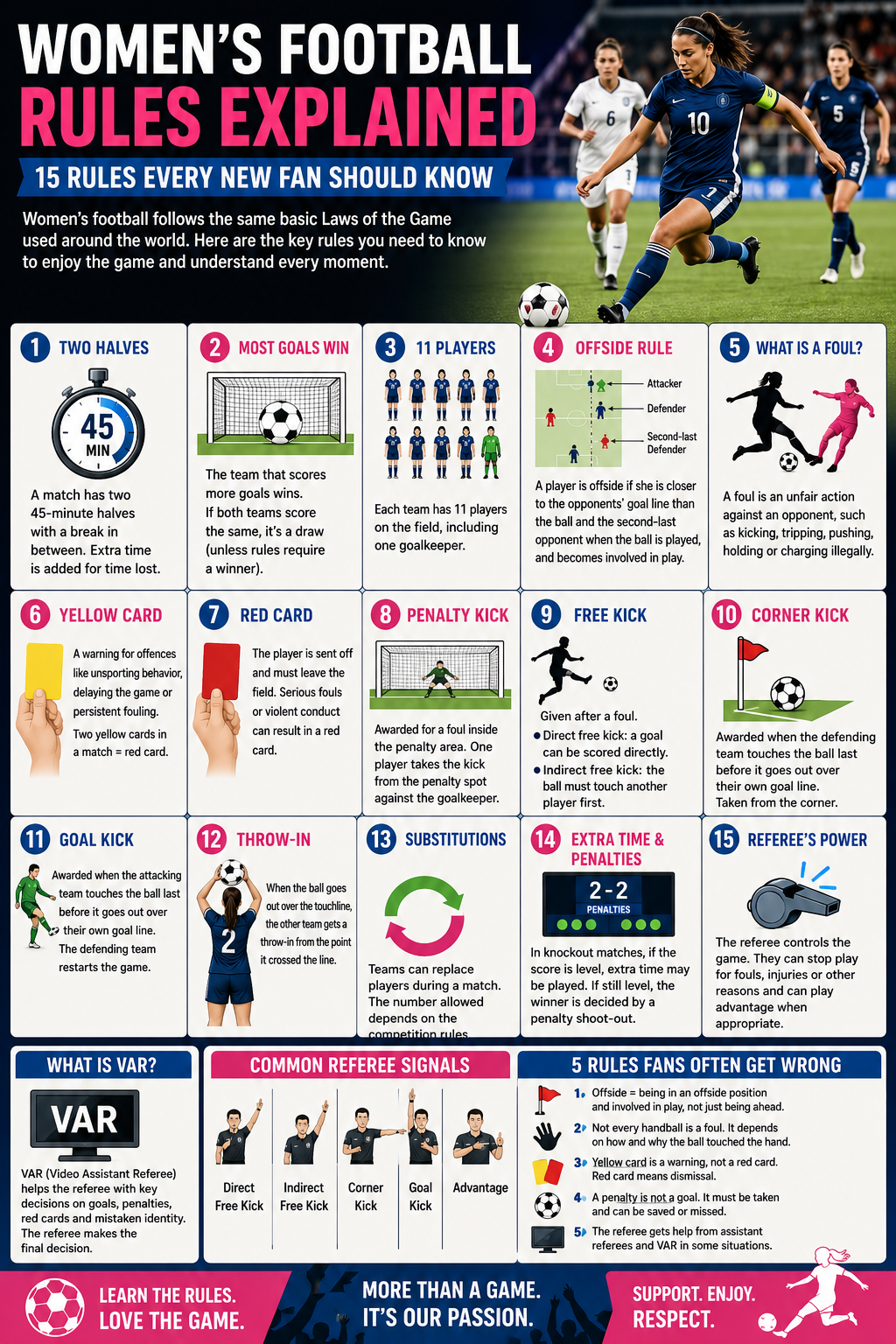
Women’s Football Rules Explained: 15 Rules Every New Fan Should Know
New to women’s football? Learn 15 simple football rules, including offside, fouls, penalties, substitutions, cards, free kicks and extra time.
A Football Match Has Two Halves
A normal football match is played over two 45-minute halves.
There is a break between the two halves, usually called half-time.
The referee can also add extra minutes at the end of each half for time lost because of injuries, substitutions, delays and other stoppages.
The exact amount of added time depends on what happened during the half.
The Team With More Goals Wins
This is the simplest rule.
A team scores when the whole of the ball crosses the goal line between the goalposts and under the crossbar, provided no attacking offence has occurred.
At the end of normal playing time:
Team A scores 3 goals
Team B scores 1 goal
Team A wins 3–1.
If both teams score the same number of goals, the match can end as a draw unless the competition rules require a winner.
There Are 11 Players on Each Team
A team normally starts with 11 players, including one goalkeeper.
The goalkeeper has a special role and can use her hands inside her own penalty area, subject to the Laws of the Game.
The other players generally use their feet, head, chest and other legal parts of the body to play the ball.
What Is Offside?
Offside is one of the football rules that confuses new fans.
A player is in an offside position if, when the ball is played or touched by a teammate, she is in the opponents' half and closer to the opponents' goal line than both the ball and the second-last opponent.
But being in an offside position is not automatically an offence.
The player must become involved in active play in one of the ways described by the Laws.
This is why you may see an assistant referee raise a flag when an attacking player appears to be ahead of the defenders.
Simple Example
A striker runs behind the defenders before her teammate passes the ball to her.
If she meets the conditions for an offside offence and becomes involved in play, the referee can stop the attack.
Offside is mainly designed to stop attackers from simply waiting near the opponent's goal for easy passes.
What Is a Foul?
A foul happens when a player commits an offence against an opponent.
Examples can include:
Kicking or attempting to kick an opponent
Tripping an opponent
Pushing
Holding
Charging illegally
Handling the ball deliberately
The referee decides whether an offence has happened and what punishment is appropriate.
Not every physical contact is a foul.
Football is a contact sport, so some challenges are allowed.
What Is a Yellow Card?
A yellow card is a warning from the referee.
A player can receive one for offences such as unsporting behaviour, delaying the restart of play, persistent fouling or other offences listed in the Laws.
A player who receives a yellow card can normally continue playing.
However, receiving another yellow card in the same match can result in a red card and dismissal, depending on the circumstances.
What Is a Red Card?
A red card means the player is sent off.
The player must leave the field and cannot be replaced.
Red-card offences can include serious foul play, violent conduct, denying an obvious goal-scoring opportunity in certain circumstances, or receiving a second caution in the same match.
A red card can change the entire game because the team has to continue with fewer players.
What Is a Penalty Kick?
A penalty kick is awarded when a player commits a direct-free-kick offence inside her own penalty area.
The ball is placed on the penalty mark.
One attacking player takes the kick against the goalkeeper.
It is one of the biggest scoring chances in football, but it is not an automatic goal.
The goalkeeper can save it.
The player can also miss the target.
What Is a Free Kick?
Free kicks are awarded after certain offences.
There are two main types:
Direct Free Kick
A goal can be scored directly from a direct free kick.
Indirect Free Kick
The ball must touch another player before a goal can be scored.
The referee indicates an indirect free kick by raising an arm and keeping it raised until the ball touches another player or goes out of play.
What Is a Corner Kick?
A corner kick is awarded when the whole ball passes over the goal line, having last been touched by a defending player, and no goal has been scored.
The attacking team takes the kick from the corner area nearest to where the ball went out.
Corners can create dangerous scoring opportunities.
Teams often have special routines for them.
What Is a Goal Kick?
A goal kick is awarded when the whole ball passes over the goal line, having last been touched by an attacking player, and no goal has been scored.
The defending team restarts play from inside its goal area according to the Laws.
Goal kicks can now be used to start attacks from the back rather than simply sending the ball as far away as possible.
What Happens When the Ball Goes Out?
If the ball completely crosses the touchline, the other team gets a throw-in.
The throw-in is taken from the point where the ball crossed the line.
The player taking the throw must follow the required technique, including delivering the ball with both hands from behind and over the head.
The player cannot score directly from a throw-in.
How Do Substitutions Work?
Teams can replace players during matches according to the competition's rules.
The number of substitutions allowed can differ between competitions.
A player who is substituted leaves the field and normally does not return unless the competition uses rules that allow return substitutions.
Substitutions are important because they allow coaches to:
Replace tired players
Change tactics
Respond to injuries
Strengthen the attack
Protect a player from further workload
Change the team's formation
What Happens If a Knockout Match Ends in a Draw?
This depends on the competition.
Some competitions allow a match to end in a draw during certain stages.
Others require a winner.
If a winner is needed, the competition may use:
Extra time: Two additional periods are played.
Penalty shoot-out: If the teams are still level, players take penalties to decide the winner.
The exact format depends on the competition's regulations.
Why Does the Referee Sometimes Stop the Game?
The referee is responsible for controlling the match.
The referee can stop play for reasons such as:
Fouls
Injuries
Serious incidents
A player needing medical attention
Interference from outside the field
Other situations covered by the Laws
The referee can also allow play to continue after certain offences when doing so benefits the team that was fouled.
This is called advantage.
What Is Advantage?
Imagine a defender commits a foul, but the attacking team immediately gets a clear chance to score.
Instead of stopping the game, the referee may allow play to continue.
The referee is effectively saying: the attacking team has a better opportunity by continuing.
If the expected advantage does not happen, the referee may apply the appropriate action under the Laws.
What Is VAR?
VAR means Video Assistant Referee.
It is used in competitions that have implemented the system.
VAR can assist the referee with certain important decisions, including:
Goals and offences leading to goals
Penalty decisions and offences leading to penalties
Direct red-card decisions
Mistaken identity
VAR does not mean every decision on the pitch is automatically reviewed.
It is used within specific areas of the Laws and competition procedures.
The referee remains responsible for the final decision.
Why Do Referees Use Different Whistles and Signals?
Referees use whistles and hand signals to communicate decisions clearly to players, coaches and spectators.
For example, a referee may signal:
Direct free kick
Indirect free kick
Advantage
Corner kick
Goal kick
Penalty kick
Assistant referees also use flags to help communicate decisions such as offside and when the ball has gone out of play.
What Is a Handball?
Handball rules can be confusing because not every time the ball touches a player's hand or arm is an offence.
The referee considers factors described in the Laws, including whether the player deliberately handled the ball and other circumstances.
There are also specific rules concerning a player scoring a goal or creating an immediate goal-scoring opportunity with the hand or arm.
This is one area where watching the referee's decision and the official explanation can be more useful than assuming every contact is a handball.
Why Do Players Sometimes Lie Down After a Foul?
Players can go down after contact for several reasons.
Sometimes they are genuinely injured.
Sometimes the contact causes them to lose balance.
At other times, a player may exaggerate contact.
The referee has to decide what happened and whether an offence occurred.
Players who deliberately try to deceive the referee can be punished for simulation or unsporting behaviour under the Laws.
Can a Goalkeeper Pick Up a Back Pass?
There is an important restriction here.
A goalkeeper generally cannot handle the ball when a teammate deliberately kicks the ball to her.
If the goalkeeper picks up such a deliberate kick, the opposing team can receive an indirect free kick.
There are exceptions, such as when the ball is played with another legal part of the body or is not deliberately kicked to the goalkeeper.
Why Do Players Sometimes Receive a Free Kick Inside Their Own Penalty Area?
Not every offence inside the penalty area results in a penalty.
A penalty is normally awarded for a direct-free-kick offence by a defending player inside her own penalty area.
Some offences result in an indirect free kick instead.
That is why understanding the type of offence matters.
5 Football Rules New Fans Often Get Wrong
1:Being offside means you can't be behind a defender.
Not exactly.
The player's position matters when her teammate plays or touches the ball, and she must also become involved in active play for an offside offence to occur.
2:Every handball is a foul.
No.
The circumstances matter.
3:A yellow card means the player must leave.
No.
A yellow card is a caution. A red card means dismissal.
4: A penalty is an automatic goal.
Definitely not.
The goalkeeper can save it, or the player can miss.
5:The referee makes every decision alone.
The referee is the match official with overall authority, but assistant referees and, where used, VAR can provide information and assistance.
Why Learning the Rules Makes Women's Football More Enjoyable
Understanding football rules can change how you watch a match.
Instead of simply wondering why a goal was cancelled, you can start asking:
Was the player offside?
Instead of being confused when a player receives a yellow card, you can understand what happened.
Instead of thinking every tackle is a foul, you can start looking at the type of contact and the referee's decision.
The more matches you watch, the easier the rules become.
Frequently Asked Questions
Are women's football rules different from men's football rules?
The basic Laws of the Game apply to both men's and women's football. Competition rules can create differences in areas such as substitutions, squad sizes or tournament formats.
How long is a women's football match?
A normal match has two 45-minute halves, with additional time added for certain stoppages.
How many players are on a women's football team?
A team normally starts with 11 players, including a goalkeeper.
What happens when a player gets a red card?
She is sent off and cannot continue playing. Her team normally continues with one fewer player.
What is the most confusing football rule?
Many new fans find the offside rule the hardest to understand because simply being in an offside position is not automatically an offence.
Where can I learn the official football rules?
The official Laws of the Game are published by the International Football Association Board (IFAB), which is responsible for the Laws.
You don't need to know every football rule to enjoy women's football.
Start with the basics: goals, offside, fouls, cards, penalties, free kicks, corners and substitutions.
Once these become familiar, watching matches becomes much easier.
And remember, even experienced fans sometimes disagree about difficult decisions.
That is part of what makes football exciting.